India’s electricity debate has changed. For years, the central question was how quickly the country could add capacity, extend the grid and connect consumers. At Bharat Electricity, Powergen India and Indian Utility Week 2026, held from September 1–3 at Yashobhoomi (IICC), New Delhi, the conversation had moved into a harder phase: what happens after the capacity is built? The answer that emerged from the three-day conference-cum-exhibition was not a single technology or policy measure. It was a systems problem.
Organised by The Energy & Climate Initiatives Society (ENCIS) and ITEN Media Pvt Ltd, with ENERGDIVE Insights and Market Intelligence as the host publication, the platform brought together policy, utilities, technology, finance and infrastructure under one roof.
Bhupinder Singh Bhalla, Honorary Chairperson of the Governing Council of Bharat Electricity, Powergen India and Indian Utility Week and former Secretary, the Ministry of New and Renewable Energy (MNRE), set out that proposition in his opening address. He said the three platforms had come together because the electricity system could no longer be transformed in separate pieces. Generation needs transmission; transmission needs storage; storage needs markets; markets need viable utilities; and all of them need technology, capital and institutional capacity. That became the thread running through the event.
The Question is No Longer How Much Capacity India Can Build
PK Pujari, Honorary Chairperson, ENCIS, former Chairperson of the Central Electricity Regulatory Commission, and former Secretary, the Ministry of Power, placed the transition in a broader institutional context.
India, he noted, had moved from being an electricity-deficit country to becoming the world’s third-largest producer and consumer of electricity. Citing installed capacity of about 552 GW and more than 300 GW from non-fossil sources, he argued that the next stage could not be reduced to adding another generation block. His formulation was more demanding: India needs to reimagine the grid.
That means moving from a fossil-heavy system towards one with a much larger renewable component; from a centralised architecture towards greater decentralisation; and from a largely physical network towards a system in which digital infrastructure and flexibility become part of the electricity architecture.
Four Times Today's Capacity — and a More Complicated System
Ghanshyam Prasad, Chairperson of the Central Electricity Authority, took the discussion into physical planning. His central prescription was integrated resource planning covering generation, transmission and distribution rather than treating them as separate exercises. The planning horizon, he said, is now about 10 years, with the plan revised each year dynamically. Discoms, transmission companies, generating companies and state load despatch centres need to participate in that process.
India had moved from being an electricity-deficit country to becoming the world’s third-largest producer and consumer of electricity
The scale implied by 2047 is considerable. Prasad said India could need at least four times its present capacity over the next two decades, potentially more if data centres, green hydrogen and other electricity-intensive activities expand faster than currently anticipated. He also pointed to the renewed requirement for firm capacity during non-solar hours, including nuclear, hydro and pumped storage.
Pumped storage, in his account, illustrates the speed at which the planning assumptions are changing. He cited potential of around 330 GW, compared with roughly 94 GW in 2022, with about 15 GW under construction and around 73 GW in the DPR preparation stage. He said 20–25 GW of additional DPR preparation was being contemplated each year.
That immediately creates a manufacturing question. Prasad said domestic hydro equipment manufacturing capacity was around 9–10 GW a year and would need to expand. He extended the same concern across nuclear, transmission, solar and wind: equipment manufacturing has to grow in step with the generation and grid plan s.
Transmission has to Stop Arriving after Generation
Dr D Sai Baba, Additional Secretary, Ministry of Power, framed the transmission challenge differently. India's renewable resources and its centres of demand are not located in the same geography. Solar resources are concentrated in Rajasthan and Gujarat; strong wind resources are concentrated in parts of southern India; hydro resources are concentrated largely in the Himalayan and northeastern regions. That geographical mismatch, he argued, requires a shift from transmission following generation to transmission enabling generation.
He cited around ₹4 lakh crore of transmission projects intended to evacuate 266 GW of energy, along with 600 GVA of transformation capacity being planned. He said future transmission planning needs to consider power flows across time, rather than simply installed gigawatts, with the objective of moving more clean electricity through the network where technically and economically feasible while controlling costs for consumers. Storage therefore enters the transmission discussion, not merely the generation discussion.
His formulation was that a 100 GW renewable feed does not mean 100 GW is available at every moment. Storage changes the temporal profile; hydro and flexible thermal generation can provide balancing capability; flexible demand can absorb surplus electricity; green hydrogen could become a large flexible load; and electricity markets can optimise these resources across regions.
Delhi's Peak Demand Makes the Problem Tangible
Ashish Sood, Minister of Home, Power, Urban Development and Education, the Government of the NCT of Delhi, brought the discussion down to the city level. Delhi's peak demand reached 8,748 MW on 29 June, surpassing the previous record of 8,656 MW, he said. Sood also cited India's all-time peak demand of 256.1 GW being met without shortage in April.
For Delhi, the issue is not merely that demand is rising. Its composition is changing, with cooling, electric mobility and digital infrastructure adding new requirements. The minister said Delhi has put in place a ₹17,000 crore power master plan through 2029 and cited ₹1,400 crore invested in a single year in strengthening transmission and distribution infrastructure, including substations and transformers.
India’s electricity transition will ultimately be executed in states, where land is acquired, generation projects are located, transmission corridors are built, distribution networks are upgraded and industrial demand materialises
The city's land constraints make the problem sharper. Sood outlined a proposed expansion of rooftop solar involving two lakh new systems, with a proposed upfront gross-benefit-incentive component alongside government subsidy. He also argued that rooftops, parking areas, public buildings and bus depots should increasingly become part of Delhi's distributed energy infrastructure.
But Delhi cannot generate every unit it consumes inside its boundaries. Sood's definition of energy sovereignty for the capital was therefore not self-sufficiency. It was a diversified and resilient portfolio connected to the national grid, backed by renewable energy, storage and the intelligence needed to manage them together.
His most useful distinction was between energy and energy at the right moment. Solar generation at noon does not solve an 8 pm cooling peak. That requires storage, flexible procurement, firm and dispatchable renewable power, demand response and more sophisticated peak management.
Sood also proposed changing the question asked of distribution networks. Instead of asking only whether a network can serve today's load, planners should ask how much new economic activity the network can host. Hosting-capacity mapping, he argued, can give businesses, EV operators, renewable developers and investors visibility on available capacity, constraints and planned augmentation.
Bihar's Message was About Execution Capacity
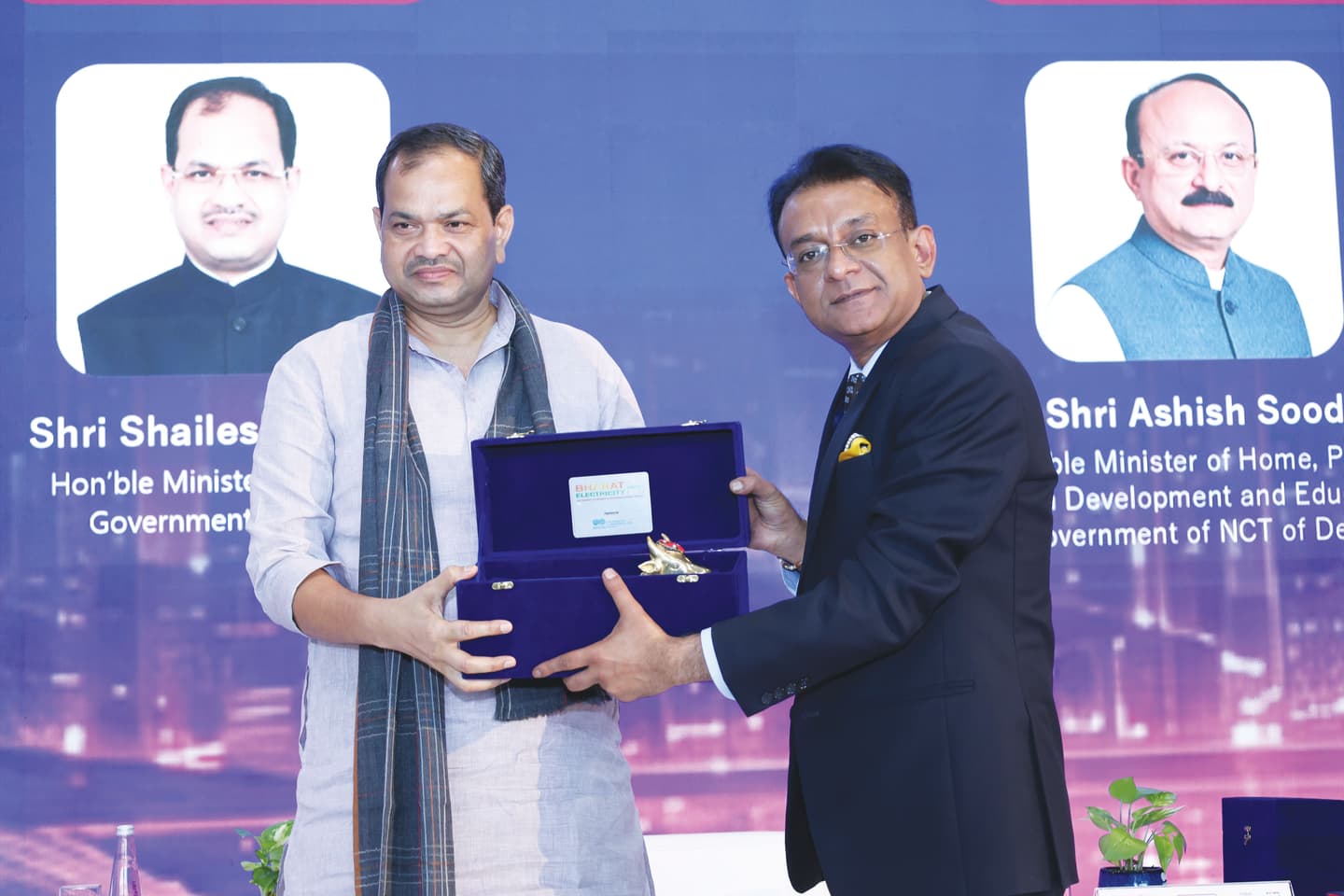
Shailesh Kumar, Minister of Energy, Bihar, used the platform to position the state as an emerging participant in the power sector build-out. The event moderator noted after his keynote that the minister had assured participants of land availability and encouraged engagement with Bihar's power sector.
The importance of that intervention sits within a larger federal theme raised by Pujari and others: India's electricity transition will ultimately be executed in states, where land is acquired, generation projects are located, transmission corridors are built, distribution networks are upgraded and industrial demand materialises.
Capital is Available; Predictability is the Scarce Commodity
The investment discussion added another layer to the same problem. The finance perspective presented at the forum was that India does not face an absolute shortage of capital for the energy transition. The harder task is reducing the risk premium attached to projects. Long-term visibility on demand, offtake, regulation and transmission can lower uncertainty and therefore the cost of capital. Resource-adequacy studies can also help create clearer pipelines of projects because they show where particular technologies and capacities will be required.
The finance perspective presented at the forum was that India does not face an absolute shortage of capital for the energy transition
The discussion also pointed towards a widening of the market beyond conventional discom power-purchase agreements. Solar Energy Corporation of India Ltd’s exploration of contracts-for-difference and other procurement structures was cited as an attempt to create additional routes for renewable and storage investment. The message was not that money is waiting for any project with a renewable label. It is that capital becomes cheaper when the underlying system makes future cash flows easier to understand.
The Industry's Next Constraint May Be Coordination
Abhishek Bhatnagar, Director General, ENCIS and CEO, ITEN Media Pvt Ltd, returned to this issue in his vote of thanks. He used the evolution of containerised shipping as an analogy: the container itself was not the transformation; the transformation came when ports, cranes, trucks, ships and countries adopted common standards. His argument was that India's electricity sector is approaching a similar point. After two decades of building assets, the next competitive advantage could come from making those assets behave as one system. He framed that transition as four shifts: from megawatts to moments; digital products to digital architecture; consumers to system resources; and liquidity policy to competitiveness policy. That neatly captured what the different speakers had said from different positions.
Bharat Electricity 2026 made a useful distinction between building the electricity system and making the electricity system work.