The energy transformation in Rajasthan is one of the country’s industrial triumphs. In just over a decade, the state transformed desert expanses into some of the world’s largest solar parks, attracted global developers and reset national tariff benchmarks. The latest figures from the Ministry of New and Renewable Energy (MNRE) confirm the scale.
Rajasthan, as of December 31, 2025, has 42,531.37 MW of renewable capacity, the second largest in the country, with largest solar portfolio at 36,658.35 MW in India. This achievement has carried the state into a more matured phase. The question is no longer how to build renewable power. But, how to make such a vast fleet serve homes, farms and industry with the reliability of a modern grid.
Solar : A Global-scale Asset
The MNRE data shows how decisive Rajasthan’s solar bet has been. The state has 31,833.08 MW of ground-mounted solar projects, 2,029 MW of rooftop solar, including PM Surya Ghar Yojana, 1,980 MW of hybrid solar component and 816.27 MW of off-grid/KUSUM component-B. Few regions have assembled such a concentrated PV base.
The spine of this system lies in the western districts. The Bhadla Solar Park in Phalodi, Jodhpur (about 2,245 MW, commissioned), the NTPC Nokh solar PV project in Jaisalmer (735 MW, fully operational in 2025), and the NTPC Fatehgarh solar plant (296 MW, commissioned).
Newer developments around Pugal in Bikaner, where a solar-plus-storage project of roughly 2,450 MW with 5,000 MWh Battery Energy Storage System (BESS) is reported as under development, indicate the shift toward firm-power assets.
Wind: Complementing the Solar Story
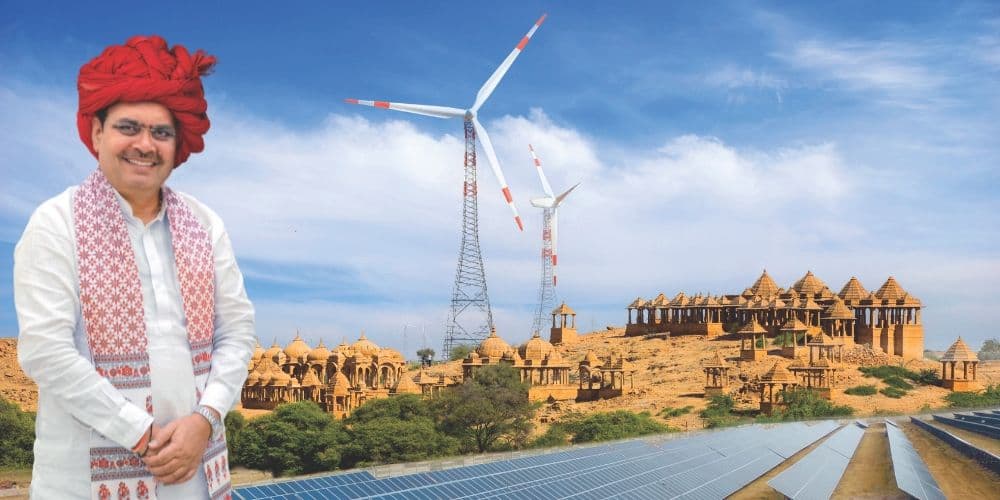
Complementing the solar fleet is 5,229.15 MW of wind capacity, making the state among India’s larger wind-power contributors despite solar’s dominance. Rajasthan’s wind potential is estimated to be around 284 GW at 150-metre hub height. Harnessing this resource could diversify a system that today is concentrated around midday solar.
Developers have urged authorities to earmark high-potential zones such as Fatehgarh and Ramgarh and reinforce transmission corridors to strengthen system reliability.
The Integrated Clean Energy Policy 2024 encourages a diversified renewables landscape, including wind–solar hybrid deployment, repowering of wind assets and energy storage systems to support grid stability and renewable integration.If land allocation and evacuation keep pace, wind can become Rajasthan’s natural counterweight, broadening seasonal output and reducing evening dependence on external supply.
Biomass and Waste: Local Reliability
Rajasthan has formalised its intent to develop biomass and waste-to-energy resources through the Rajasthan Biomass and Waste to Energy Policy, 2023, approved by the state cabinet to promote power generation from agricultural and municipal waste along with incentives for developers and grid connectivity priority.
At the project level, the Langadiyawas waste-to-energy plant near Jaipur is a notable example. Operational since early 2025, it processes about 1,000 tonnes of municipal solid waste per day and generates roughly 12 megawatts of electricity under a public-private partnership, helping reduce landfill dependency while supplying power. Vegetative and crop residues also support smaller biomass efforts, and policy support under the 2023 guidelines aims to increase utilisation of such feedstocks to reduce stubble burning and provide steady generation that is not dependent on sunshine or wind. These assets add dispatchable generation to Rajasthan’s largely solar and wind mix and create local value chains in waste handling and biomass utilisation, complementing the state’s broader renewable transition.
Compressed Biogas (CBG): Energy beyond Electricity
In Rajasthan, the transition from electrons to molecules has begun with a concrete milestone. Under the Government of India’s Sustainable Alternative Towards Affordable Transportation (SATAT) programme, the state’s first commercial CBG facility came online in Ajmer in July 2025, when Indraprastha Gas Ltd commissioned a plant with an installed capacity of about 6 tonnes per day of CBG. This marks Rajasthan’s first operational step into renewable gas production and illustrates how waste can become a clean-fuel feedstock. Further activity signals broader interest, as an Engineering, Procurement and Construction (EPC) contract was reportedly awarded for a 5 TPD CBG project in Jaipur, which will use Napier grass and other biomass feedstocks once complete, demonstrating developer engagement in scaling bioenergy capacity. In addition, Rajputana Biodiesel Ltd reportedly secured approvals from the Rajasthan Renewable Energy Corporation Ltd (RRECL) to establish 5 TPD CBG facilities in Ajmer and Nagaur, reflecting state policy support for new waste-to-fuel projects under the Integrated Clean Energy Policy 2024.
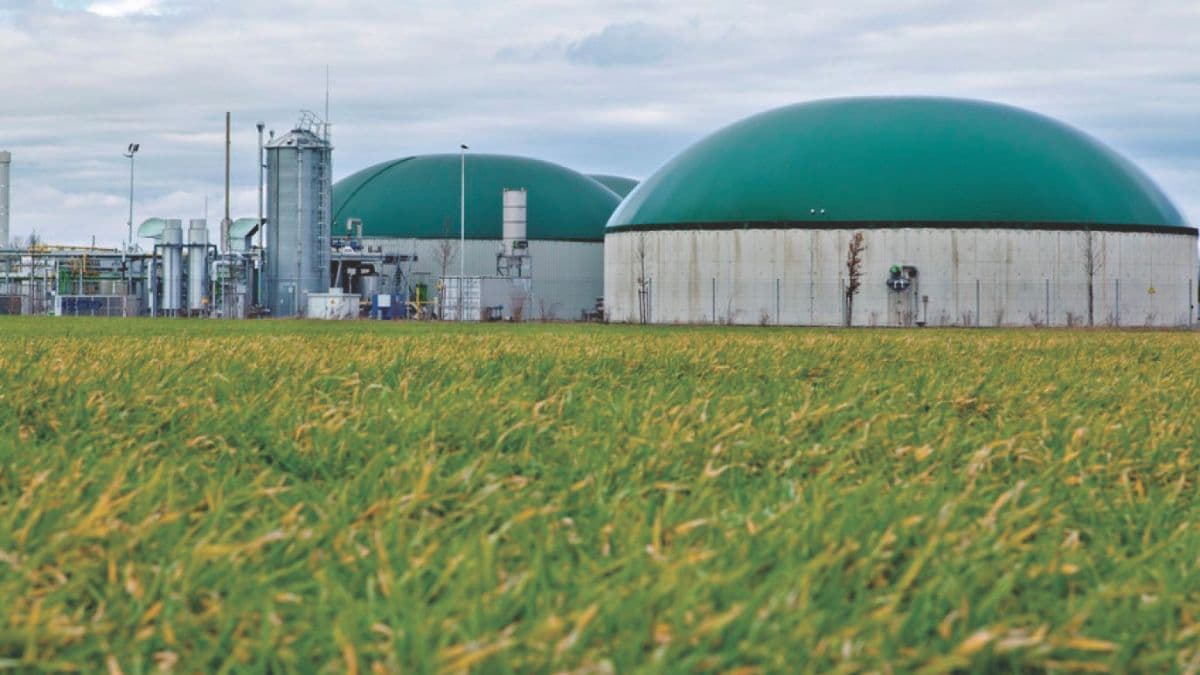
Although CBG is still nascent compared with solar and wind capacity, it adds a molecule-based pathway to Rajasthan’s energy portfolio, linking organic waste management with clean fuel supply and local economic activity.
Hydrogen: Preparing the Next Industry
Rajasthan’s move into green hydrogen is at an industrial pilot stage. The state notified a draft Rajasthan Green Hydrogen Policy in 2023, positioning hydrogen and ammonia as future manufacturing pathways rather than as grid electricity projects.
Two early demonstrations illustrate this direction. In 2025, INOX Air Products (INOXAP) commissioned a solar-powered green hydrogen plant at AIS’ Chittorgarh facility, a first such unit for float glass in the country, driving sustainable manufacturing with AIS. Designed to produce up to 190 TPA of green hydrogen through electrolysis, the plant will initially provide 95 TPA to AIS.
In Bikaner, Acme built one of the world’s first green ammonia plant in 2021. The integrated green hydrogen–ammonia pilot uses dedicated renewable power to test production and logistics for fertiliser and export markets. These projects establish operating experience in electrolysis, storage and safety standards. For Rajasthan, hydrogen’s relevance flows from geography and industry. The state hosts cement and mineral clusters, glass manufacturing and fertiliser demand in neighbouring regions—sectors where direct electrification is difficult. Co-locating electrolysers with large solar-wind zones and using treated municipal water are being explored to reduce environmental pressure. The pathway remains gradual. Electrolyser costs, water availability, transport of ammonia and long-term purchase contracts are the decisive variables. At present, hydrogen complements Rajasthan’s renewable expansion rather than defining it, yet it signals how the state’s vast solar-wind electricity base could eventually support fuels and chemicals beyond the grid.
Policy Momentum
The Union Budget 2026 reinforced this trajectory by allocating ₹32,914.7 crore to renewable energy. This is about a 30 percent increase from the revised estimates of ₹25,301.22 crore for 2025-26 and earmarking ₹22,000 crore for the Pradhan Mantri Surya Ghar: Muft Bijli Yojana, marking a 29 percent increase from the revised estimates of ₹17,000 crore for 2025-26. These central allocations, focused on grid upgrades, rooftop adoption and storage-linked deployment, signal policy support for the integration phase that states such as Rajasthan are now entering, moving beyond capacity addition toward system reliability .
For Rajasthan, where rooftop and feeder-level solar are expanding rapidly, these schemes provide the financial spine for distribution modernisation and demand-side balancing. What distinguishes Rajasthan now is not new capacity but new outcomes. The state is beginning to measure success in hours of firm delivery, feeder stability and industrial offtake rather than in megawatts alone. Discoms are testing time-of-day procurement, and planners are mapping hosting capacity feeder by feeder—metrics that did not exist in the first solar decade.
The next benchmark will be how quickly wind repowering, batteries at substations and hybrid contracts translate into visible evening supply. Equally decisive will be the ability of CBG clusters and early hydrogen users to create steady non-power demand for renewable electricity.
If these operational pieces mature, Rajasthan’s contribution will extend beyond its own grid: it will show how a solar-heavy state can evolve into a reliable, diversified energy system, a path many others in India will soon need to follow.