Gujarat’s stature in the country’s power and utilities sector has been built incrementally rather than through a single reform. The state’s electricity system shaped by capacity addition, transmission development, renewable development and market participation progressed in overlapping phases. This has coincided with the state’s ability to integrate large volumes of renewable capacity, operate close to power balance, and supply electricity to energy-intensive industrial clusters.
Capacity Adequacy as a Design Choice
The first differentiator of Gujarat is that it addressed adequacy early. It built a large and diversified generation base across coal, gas, nuclear and renewables. The baseload’s major supply remains thermal power for refineries, ports, petrochemicals, ceramics and manufacturing. The peaking and balancing flexibility was ensured by the gas-based plants near Liquefied Natural Gas (LNG) terminals at Dahej and Hazira. Adding firm and low-carbon capacity, the Kakrapar Atomic Power Station. The state enjoys a persistent power surplus owing to the diversified mix. Besides, Gujarat has occupied a place among other states that were able to meet energy requirements with surplus availability, as per the union power ministry’s state-wise power supply report.
Renewable Scale without Grid Breakdown
Distinguishing itself from other high-renewable states is Gujarat’s execution, not mere ambition. The state’s installed renewable energy capacity stood at 35.16 GW as of April 30, 2025.
This transformed the state into the largest renewable energy state in the country, with solar and wind commanding the energy mix supplemented by hydro and bio-energy at that time.
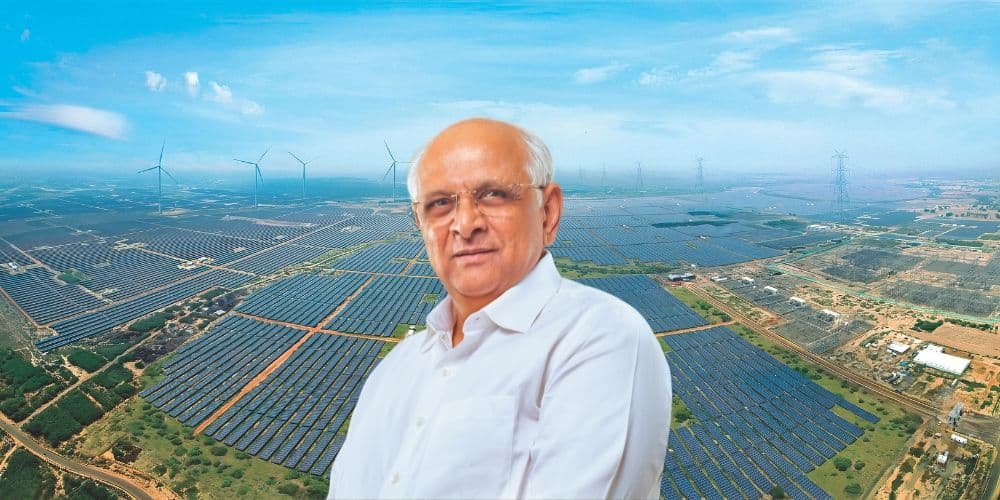
Equally notable is the speed of addition. Taking the lead, Gujarat added 8.5 GW of renewable capacity from January to September 2025, pushing the total installed renewable energy capacity towards the 40-GW mark by the third quarter. The expansion is led by projects such as the Khavda hybrid renewable energy park, planned as one of the world’s largest solar-wind installations.
The state planned transmission for renewable-rich regions such as Kutch and Saurashtra alongside capacity expansion. Hand-in-hand developed were evacuation schemes under national transmission planning frameworks. As renewables increasingly penetrated, this parallel development assisted to manage grid integration. Experiences across power systems, more broadly, show that where transmission lags generation, high renewable penetration can strain grids. In Gujarat, grid readiness formed a central part of the renewable build-out strategy.
Transmission as Economic Infrastructure
Another part of Gujarat’s power story is transmission supported by robust intra-state networks and inter-state connectivity. Especially around renewable integration, Gujarat’s transmission planning aligns with national priorities identified by the Central Electricity Authority (CEA). This is also visible in new industrial energy planning. Adani Energy Solutions reportedly won a ₹28-billion transmission project in the state designed to supply a green hydrogen and ammonia manufacturing facility in Mundra in March 2025. The project points to alignment between transmission investment and emerging clean-industry demand.
Distribution Discipline and Financial Signals
Typically, the country’s power sector failures concentrate at the distribution level, but Gujarat’s discoms have remained comparatively disciplined owing to feeder separation, energy accounting and periodic tariff revisions. While not immune to stress, Gujarat’s utilities have avoided the chronic loss spirals seen elsewhere. According to the India Climate & Energy Dashboard of NITI Aayog, which publishes state-level utility indicators, Gujarat’s aggregate technical and commercial losses were well below the national average at around 9.1 percent in FY 2023–24.
In the same period, transmission and distribution losses were reported at about 14 percent. As large-scale renewable integration and market participation rely on the ability to bill, collect and reinvest for the utilities, the metrics matter a lot.
Market Orientation Rather than Administrative Allocation
By Indian standards, Gujarat’s power ecosystem is unusually market-oriented. Alongside conventional procurement mechanisms, utilities and large consumers make use of short-term power markets and bilateral contracts, allowing price signals to play a role in dispatch and procurement decisions. As power markets rely on the physical ability to move electricity without persistent congestion, such participation is supported by strong intra-state and inter-state grid connectivity.
In Gujarat’s case, transmission planning has complemented market mechanisms rather than operating in isolation from them.
Policy Continuity Over Policy Churn
A look into Gujarat Renewable Energy Policy reveals articulation of the state’s direction with clarity. The policy states an objective to reach around 50 percent renewable energy in cumulative installed capacity by 2030. It also estimates investment potential of about ₹5 lakh crore across generation, transmission and manufacturing.
The importance of the policy lies less in the target and more in continuity. Remarkably, over several years, renewable auctions, grid expansion and industrial energy planning have remained continued, allowing institutions to mature rather than reset.
Gujarat’s claim to fame in power and utilities sector is not innovation theatre, but a system discipline. Adequacy was established before ambition; transmission was treated as infrastructure, not an afterthought; renewables were scaled only once the grid could absorb them; and distribution utilities were kept functional enough to support markets and decentralisation. The outcome is a power system that can carry industrial growth, integrate clean energy at scale and remain financially legible to investors. In a sector where many states struggle to reconcile reliability, sustainability and cost, Gujarat’s experience shows that sequencing, not slogans, is what ultimately delivers resilience.