The union government has extended the Approved List of Models and Manufacturers (ALMM) framework to include ingots and wafers. The Union Ministry of New and Renewable Energy (MNRE) has said that every module used in a government-backed solar project must trace its wafers to an Indian factory on a new ALMM List-III from June 1, 2028. It is the deepest the government has ever reached into the solar supply chain. Currently, the country produces around 2 GW of ingots and wafers every year, as per the ministry.
Why Ingots and Wafers are Critical
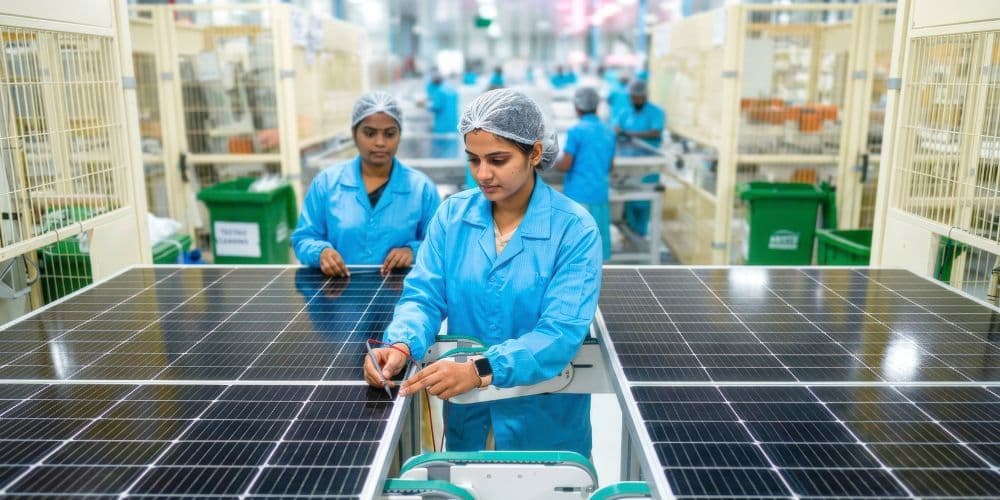
A solar panel is the visible end of a long manufacturing sequence. At the base sits polysilicon, an ultra pure silicon refined from quartz. Polysilicon is melted and drawn into ingots, which are sliced by wire saws into wafers about 180 microns thick. Those wafers are treated and doped to become solar cells, which are assembled into modules to power solar parks and rooftops. It is in the ingot and wafer stage where raw material becomes photovoltaic component.
ALMM List-I (solar PV modules) has grown from 8.2 GW in 2021 to around 172 GW. ALMM List-II (solar PV cells) has reached 27 GW within seven months.
Wafers are the critical intermediate stage between polysilicon and solar cells. India has limited wafer manufacturing capacity and relies substantially on imports. Control of this stage confers traceability and insulation from import disruptions at the most upstream point before cells are made.
Since ALMM was introduced, domestic solar manufacturing has expanded significantly. ALMM List-I (solar PV modules) has grown from 8.2 GW in 2021 to around 172 GW. ALMM List-II (solar PV cells), introduced more recently, has already reached 27 GW within seven months, demonstrating the framework’s effectiveness in stimulating domestic investment. However, this entire downstream base depends on imported wafers. Notably, MNRE’s March 2026 order is designed to end that dependency. The government is applying the same logic to ingots and wafers, with the difference that this segment starts from a much lower base against a much tighter deadline.
Where India Stands
The contrast between India’s downstream solar manufacturing strength and its upstream exposure is sharpest. Module and cell manufacturing have responded rapidly to policy signals and demand visibility. In comparison, wafer manufacturing, which requires more capital-intensive equipment and greater technical precision in crystal growth, are at an early stage of capacity expansion. The country’s ingot and wafer manufacturing capacity, at around 2 GW based on official estimates, remains below around 15 GW threshold identified for the notification of List-III. This indicates that upstream capacity expansion is still underway. At the global level, the concentration of ingot and wafer manufacturing remains particularly high, with China accounting for approximately 97 percent of output, according to the International Energy Agency. This concentration provides the broader structural context within which India’s upstream solar manufacturing ecosystem is evolving.
Investment already in Motion
The policy signal has preceded the formal order. Waaree Energies broke ground on March 16, two days before the MNRE’s announcement, on a 10 GW capacity each for solar ingots and wafers, by setting up it as India’s largest integrated ingot and wafer manufacturing complex at Butibori in Nagpur, Maharashtra. The 300-acre complex will be built with an investment of approximately ₹6,200 crore and is expected to generate over 8,000 direct and indirect jobs when operational. By strengthening domestic capabilities in these upstream components, the project is likely to significantly reduce India’s reliance on imported materials, enhance supply chain stability, and support the nation’s long-term goal of achieving energy security through self-reliant clean energy manufacturing.
The June 2028 timeline is a ceiling, as the mandate is contingent on three conditions being met
When completed at announced capacity, Waaree’s facility would alone take the country nearly two-thirds of the way to the 15 GW List-III threshold. The mandatory ingot integration clause in the MNRE order aligns closely with Waaree’s design: the facility produces both ingots and wafers at equivalent scale, which is precisely ALMM List-III enlistment will require. Besides, Tata Power announced plans in December 2025 to set up a 10 GW solar ingot and wafer manufacturing facility by pumping around ₹6,500 crore in capital investment.
Also, Indosol Solar is developing upstream solar manufacturing capabilities with ingot and wafer production forming a core part of its integrated value chain. As part of its Phase I plan, the company is targeting a 10 GW ingot-to-module facility by December 2026, with ingot and wafer manufacturing embedded within this scale-up. For this phase, an investment of ₹25,000–28,000 crore will be pumped. It is designed to support backward integration into critical intermediates, reducing reliance on imported wafers and ingots.
What Must Happen before the Mandate can Activate
The June 2028 timeline is a ceiling rather than a guarantee. The mandate is contingent on three conditions being met: the operationalisation of at least three independently owned manufacturing units, the achievement of a cumulative 15 GW capacity and the formal notification of ALMM List-III by the MNRE. Following this notification, a short transition window applies, after which applicable projects are required to procure ALMM List-III compliant wafers.
Until these conditions are fulfilled, the requirement to use ALMM-listed wafers does not come into force, regardless of the date. This design ensures that compliance is aligned with the availability of adequate domestic supply. However, the order unambiguously sets a forward-looking investment signal. Visibly, such signals have driven rapid capacity expansion in modules and cells in earlier phases of the ALMM framework. The extension to ingots and wafers applies the same policy logic further upstream.
For manufacturers, the implication is clear: participation in India’s solar market beyond 2028 will depend on alignment with ALMM List-III, either through sourcing from compliant suppliers or by building integrated upstream capacity.