The country’s power sector has undergone a structural transformation. What was once a system constrained by financial stress, fuel uncertainty and uneven electrification is now evolving into a complex, renewable-integrated grid. The transition has moved beyond capacity addition to systemic reform, strengthening distribution finances, deepening power markets, expanding transmission and embedding flexibility. As renewable capacity accelerates towards the 500 GW target, managing variability, storage and demand synchronisation is becoming the sector’s defining challenge.
Before 2014: Expansion without Elasticity
The country’s electricity system was large, however, structurally uneven in 2013-14. Its total installed power generation capacity was about 249 GW. The thermal power’s share was nearly 69-70 percent with coal domination, hydro power at approximately 40 GW and nuclear below 5 GW. The renewables comprising wind, solar, biomass and small hydro was 31 GW. Commanding the share in the renewable energy pie was wind and solar’s installed capacity was less than 3 GW. Structurally, renewable energy was not integrated into pan-India load planning.
The state DISCOMs, as per the power ministry’s data from the period, accumulated debt of ₹3-4 lakh crore, which affected their ability to purchase power or invest in boosting the network.
During the period, the Aggregate Technical and Commercial (AT&C) losses was over 22 percent, all India, with many states recording materially higher figures. This meant that over 20 percent of electricity fed into distribution networks did not realise billing and revenue. Many states experienced persistent gap between Average Cost of Supply (ACS) and Average Revenue Realised (ARR), which led to structural annual losses for distribution companies (DISCOMS).
The state DISCOMs, as per the power ministry’s data from the period, accumulated debt of ₹3-4 lakh crore, which affected their ability to purchase power or invest in boosting the network.
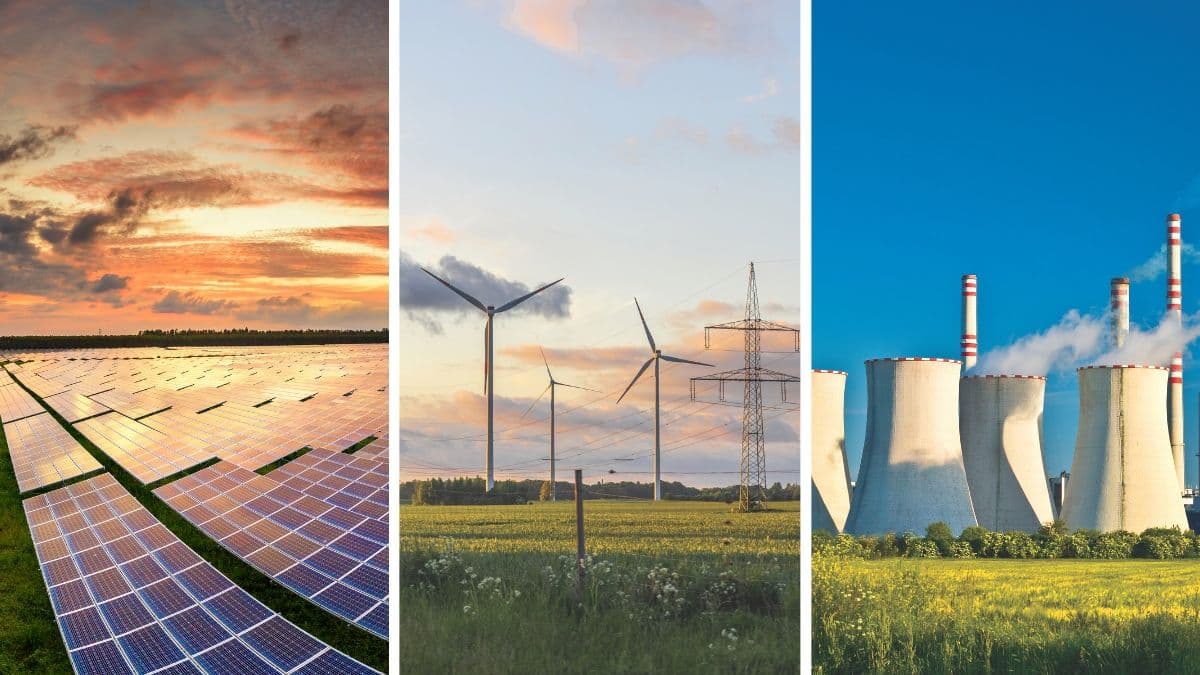
Wind, solar, and nuclear power representing India’s gradual shift toward a more diversified and renewable energy system.
The generators realised delay in payment routinely, which impacted their cash flow. This stress cascaded backwards through the system, affecting fuel procurement, maintenance expenditure and capital expansion.
Notably, India also experienced structural risk as fuel supply volatility compounded. Observing allocation process irregularities, the Supreme Court had cancelled over 200 coal block allocations.
Although corrective auctions were initiated later, the immediate impact was uncertainty in coal supply linkages. This led to a situation where power producers dependent on domestic coal faced disruption risk. Several of them had to increase their dependence on imported coal, which is priced in the global market and transacted in foreign currency, exposing generation costs to international price volatility and exchange rate movements.
During the last decade, power generation expansion was driven by large-scale coal-based capacity additions, including the Ultra Mega Power Projects (UMPP) model, which consists of 4,000 MW coal-based plants designed to scale efficiently with long-term fuel linkages.
This design is reflected in projects such as Mundra (Gujarat) and Sasan (Madhya Pradesh). The planning was based on the assumption of steady industrial growth, predictable baseload demand expansion, and a secure domestic coal supply.
Renewable energy was not viewed as central architecture, but rather as a supplementary capacity, as the grid was not being built around flexibility but rather on a coal baseload. Besides, the planning instruments remained largely deterministic and only competition and regulatory oversight were introduced by the Electricity Act, 2003. Targets on capacity addition were linked to projected peak demand growth and modest reserve margins.
There was limited formal modelling of renewable intermittency, storage requirements, extreme weather variability, demand-side management, electric mobility impact, and industrial electrification pathways. Resource adequacy was treated as capacity arithmetic, not risk modelling. When it came to market depth, power exchanges existed. But, short-term markets consisted of a relatively small fraction of total electricity traded. Balancing mechanisms were coarse, as ancillary services markets were in early stages.
While the grid operated effectively, it ran without high-frequency balancing tools, which would emerge as a critical aspect in a renewable-heavy system. While rural electrification had progressed, it remained incomplete in certain regions. Moreover, lakhs of homes did not have formal connections. Often agricultural feeders were not segregated, obscuring load patterns and complicating energy accounting. Many states suffered from congestion in substations, suffered from substation congestion, overloaded transformers and inadequate metering.
2014-2019: Fixing the Leaking Pipes before Expanding the Grid
From 2014 to 2019, renewable dominance or storage sophistication was not the immediate priority, but rather stabilising the base. The focus was brought into electrification, feeder accountability, debt restructuring, coal linkage rationalisation and tariff correction. As village electrification was incomplete and household access uneven, key interventions were to boost rural feeder and agricultural feeder segregation under the Deen Dayal Upadhyaya Gram Jyoti Yojana (DDUGJY) launched in December 2014. Segregation allowed more accurate measurement of agricultural consumption and reduced cross-subsidy distortion. The outcome: all census villages had been electrified by April 2018.
Over 2.6 crore households had been connected to the grid under the scheme by March 2019.
But, village electrification did not equate to household electrification. Targeting last-mile household connectivity, the Pradhan Mantri Sahaj Bijli Har Ghar Yojana or Saubhagya was launched in 2017. Over 2.6 crore households had been connected to the grid under the scheme by March 2019. The effect was structural, as electrification did not remain a macro statistic, but a household-level entitlement. This access expansion led to the demand formalisation, with consumers who previously relied on informal or off-grid sources entering the billing ecosystem, widening the revenue base.

A student studies under electric light in a rural home, reflecting India’s push for universal household electrification through programmes such as Saubhagya and DDUGJY.
In parallel to intervention in the rural landscape, the urbanscape was targeted by the Integrated Power Development Scheme (IPDS) with the ₹32,000-crore-plus outlay. The sub-transmission networks reduced transformer overloading and expanded feeder metering was strengthened.
Notably, feeder metering is foundational reform as losses cannot be accurately identified in the absence of accurate energy measurement of energy flows at the feeder level. Accountability in distribution utilities was strengthened with feeder metering expansion under the two schemes. The distribution reform was moving from asset creation to measurement discipline.
Besides, DISCOMs were under financial stress, as they had to service interest for debt of over ₹4 lakh crore, constraining cash flows. Power purchase obligations were often met through short-term borrowing. Launched in November 2015, the Ujwal DISCOM Assurance Yojana (UDAY) brought relief for DISCOMs, as 75 percent of their debts could be taken over by the states by issuing UDAY bonds and State Development Loan (SDL). Over ₹2 lakh crore of DISCOM debts were taken over under the scheme by 2018. The bond refinancing lowered rates and slashed costs compared to earlier borrowing costs. States committed to operational efficiency targets, including loss reduction and gap elimination between ACS and ARR. UDAY stabilised the immediate fiscal pressure that had paralysed procurement and investment. As uncertainty over fuel supply was a systemic vulnerability, the SHAKTI (Scheme for Harnessing and Allocating Koyala Transparently in India) policy was introduced in 2017.
The scheme stabilised coal supply agreements and reduced discretionary allocation risk by rationalising coal linkages for the power sector through transparent allocation mechanisms. This led to a more structured coal procurement, which began to stabilise plant load factors in segments that experienced fuel linkage constraints.
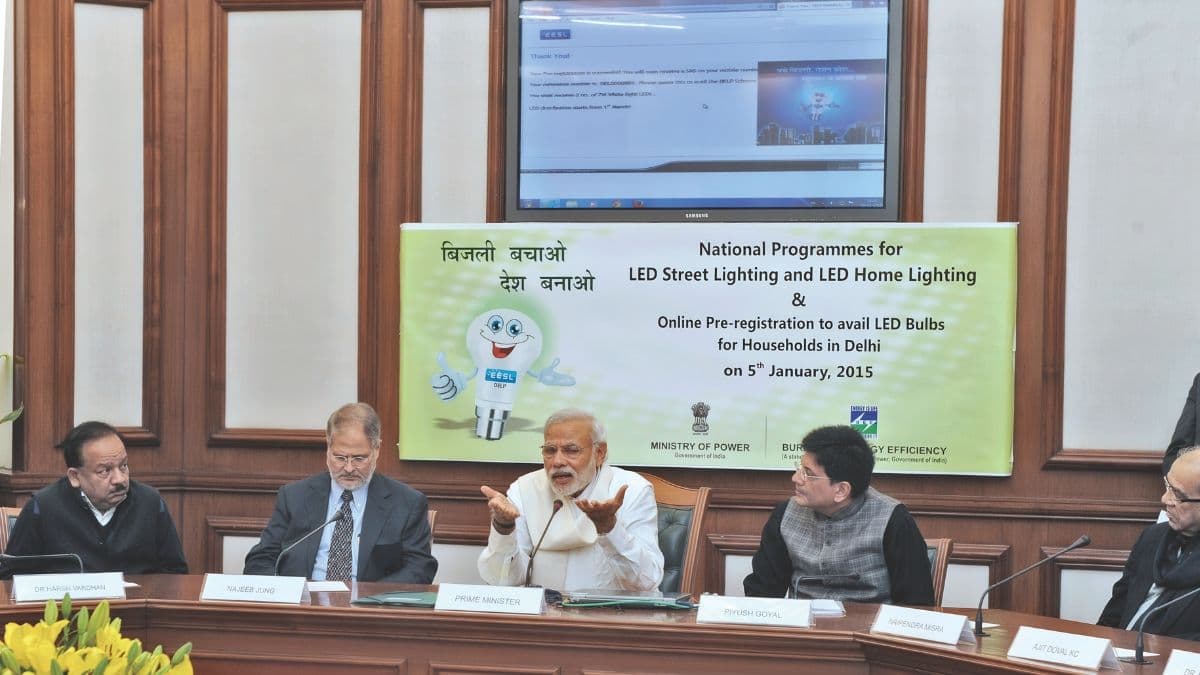
Government leaders discuss the rollout of national LED lighting programmes under UJALA and SLNP to improve energy efficiency and reduce electricity demand.
What is more, the demand side was also intervened when the UJALA (Unnat Jyoti by Affordable LEDs for All) programme, rolled out in January 2015, distributed subsidised 35-crore-plus LED bulbs across India by the state-owned Energy Efficiency Services Ltd. By replacing energy intensive incandescent bulbs, the programme moderated peak demand growth by slashing the lighting load intensity of households, delivering an estimated annual energy savings of over 45 billion kWh as well as reducing peak demand by 8-9 GW. Besides, urban local bodies realised improved lighting efficiency with the Street Lighting National Programme (SLNP) launched in the same year. Cumulatively, these interventions reduced peak stress and flattened demand curves and efficiency became a supply-side instrument.
Alongside repairing the distribution pillar, focus was also on renewable acceleration. With solar auctions, competitive tariff discovery was introduced. From above ₹7 per unit in the mid-2010s, solar tariffs decreased below ₹3 per unit in auction rounds 2017 onwards. Reducing project risk, the Solar Park Scheme aggregated land and evacuation infrastructure. Besides, wind energy transitioned to competitive bidding. Also, the Wind-Solar Hybrid Policy, introduced in 2018, encouraged co-located generation, improving transmission utilisation. Renewable capacity expanded from around 31 GW in 2014 to about 80 GW by 2019. Solar, in particular, moved from marginal capacity to a structural contributor.
2019-2024: From Expansion to System Architecture
When the COVID-19 pandemic struck the world, it stress-tested the power system in ways no planning model had anticipated. The lockdown that ensued a sharply-fallen electricity demand, but fixed costs such as power purchase agreements, capacity charges, employee obligations remained constant. When liquidity buffers were thin, DISCOMs faced revenue compression. This situation was addressed after the government infused liquidity through Power Finance Corporation Ltd (PFC) and REC Ltd. The initial tranche was about ₹90,000 crore, which increased to over ₹1.35 lakh crore in sanctioned support.
The intervention prevented a cascading effect of defaults across generators and fuel suppliers. This was a systemic shock absorber unlike earlier debt restructuring, helping the electricity sector pass its most severe demand contraction test without structural collapse.
But liquidity support alone would not restore discipline. In 2022, the Electricity (Late Payment Surcharge and Related Matters) Rules (LPS) Rules were notified, creating a structured payment mechanism for clearing dues and capping the DISCOMs’ ability to schedule power if dues remained unpaid beyond defined thresholds. The effect was immediate and measurable: outstanding dues that had surged during pandemic stress fell sharply within two years of LPS implementation of the rules.
Approved in 2021, the ₹3.04 lakh crore Revamped Distribution Sector Scheme (RDSS) consolidated earlier distribution schemes, including IPDS and DDUGJY. However, its architecture differed as funding was linked to measurable outcomes such as AT&C loss reduction, ACS–ARR gap elimination, smart meter rollout and infrastructure strengthening.
Central to reform was smart meters as prepaid and time-of-day capable metering changed consumer behaviour, reduced billing inefficiency and improved cash flow cycles. Distribution reform transitioned from capital infusion to accountability architecture.
Moving beyond the earlier captive mining model, coal supply reform deepened with the beginning of 2020 when commercial coal mining auctions allowed private entities to mine and sell coal in the open market. This diversified supply sources and reduced structural dependence on administrative linkage allocation. In the mid-2020s, coal production crossed 800 million tonnes from 565 million tonnes in FY 2013–14. This showed structural supply expansion. Fuel security became more predictable.
With the increased renewable penetration, coal plants are required to run differently. The Central Electricity Authority issued flexibilisation guidelines, which reduced the technical minimum operating level, even to around 55 percent of rated capacity in some cases. No longer is coal generation treated purely as baseload; it became a balancing support for variable renewable output.
Market deepened when the Real Time Market (RTM) was introduced in June 2020. This enabled trading in 30-minute sessions in line with the country’s 15-minute scheduling blocks, which permitted participants to balance supply and demand closer to delivery. Additionally, Green Day-Ahead Market (GDAM) provided a renewable-specific trading platform. These supported the evolution of ancillary services frameworks for frequency regulation and reserve support providers. Once supplementary, electricity markets became integral to balancing.

A visual representation of smart grid technologies integrating renewable energy, digital monitoring, and real-time power management as India’s electricity system transitions toward a more flexible and digitally managed architecture.
Also, the General Network Access (GNA) regulations, introduced in 2022, reformed the transmission. The generators received pan-India grid access rights instead of long-term point-to-point connectivity rights. This enabled more flexible dispatch and integration of geographically dispersed renewable plants. The reform reduced structural rigidity in evacuation planning. Transmission ceased to be a bottleneck in principle.
Marking the most significant planning evolution in decades was the National Electricity Plan (NEP), 2022-2032. The plan projected installed capacity of more than 609 GW by FY 2026-27 and over 900 GW by FY 2031-32 in a scenario when renewable dominants.
Notably, it institutionalised storage and flexibility modelling, besides projecting a storage requirement of about 74 GW by FY 2030-31. This is by combining pumped storage and battery energy storage systems. For the first time, flexibility was embedded in formal planning.
Advanced metering infrastructure pilots, distribution automation and digital control systems accelerated with the National Smart Grid Mission launched in March 2015. Under RDSS, smart meter rollouts scaled rapidly, enabling time-of-day tariffs and improved energy accounting. The grid began transitioning from mechanical to digital.
A different system came into being by the mid-2020s when installed capacity had surpassed 400 GW and was moving towards the 500 GW milestone. Renewable capacity approached 150 GW and non-fossil’s share in installed capacity approached structural parity.
2024-2030: The Flexibility Pivot
By 2024, the domestic power sector had surpassed a decisive threshold with an installed capacity exceeding 440 GW, up from 2014’s base of nearly 249 GW. Non-fossil installed capacity crossed 200 GW in 2023 and the peak electricity demand that prevailed around 135 GW a decade ago, exceeded 250 GW during summer 2024.
This shows that the system had achieved adequacy and the central challenge was no longer deficit, but synchronisation. To be able to achieve the stated goal of reaching 500 GW of non-fossil installed capacity by 2030, almost 40-50 GW will have to be added annually in the remaining part of the decade.
What this augurs is industrial mobilisation, not incremental expansion. Parallelly, land aggregation, manufacturing supply chains, transmission corridors and financing pipelines must scale. However, generation growth alone is insufficient. At this magnitude, renewable expansion must be absorbed without destabilising dispatch economics or grid stability.
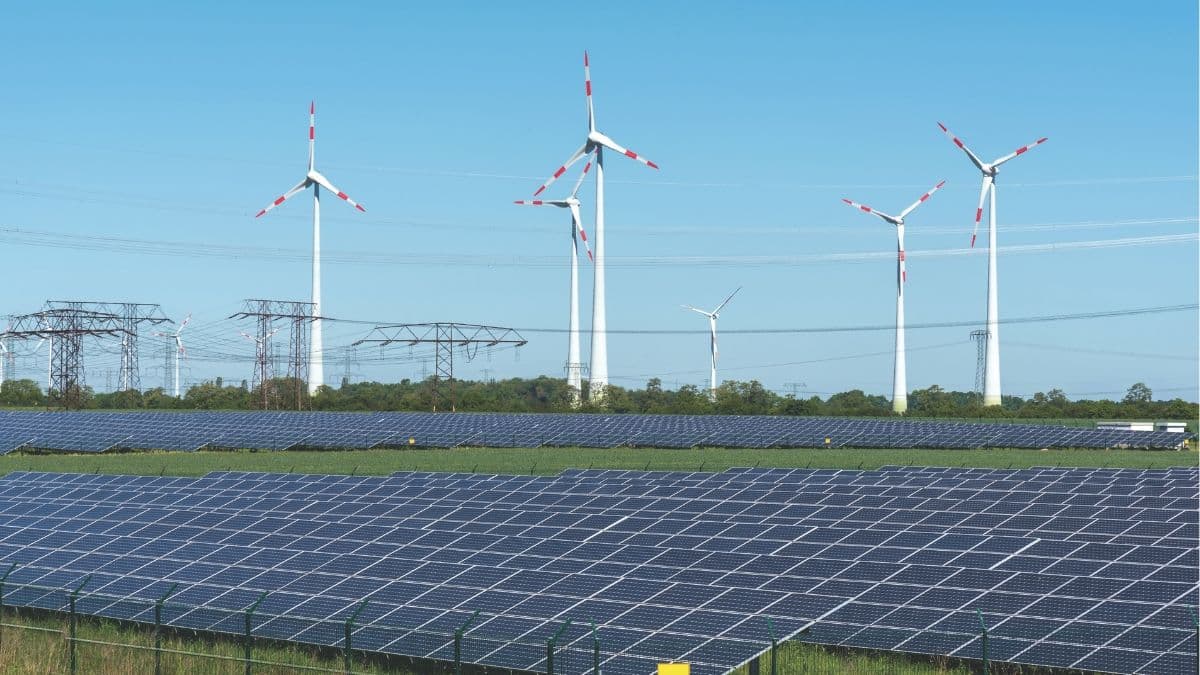
Solar panels and wind turbines connected through transmission infrastructure illustrate the growing scale of renewable energy integration as India advances toward its 500 GW non-fossil capacity target by 2030.
As the NEP (2022–2032) projects a combined storage requirement of about 90 GW by 2031-32 in a scenario of high renewable penetration, storage is therefore structural, not auxiliary. While demand peaks in the evening, solar generation peaks at midday and wind output fluctuates seasonally.
The grid-scale storage is recognised as infrastructure with the introduction of the Viability Gap Funding framework for Battery Energy Storage Systems, which supported 4 GWh of initial capacity through competitive bidding, improving their bankability and accelerating competitive procurement for renewable integration. With a long-term potential expansion towards 100 GW by the mid-2030s, pumped storage was simultaneously repositioned as a strategic flexibility asset. While the NEP’s projection on pumped storage is around 41 GW by 2031–32, India’s identified technical potential exceeds 100 GW, stressing on its long-term role in renewable-dominant grid balancing.
Coal capacity remains above 200 GW but operates under a recalibrated philosophy. Issued by the CEA, the Flexibilisation norms enable lower technical minimum operation and dynamic ramping. Increasingly, coal plays the role of a balancing reserve, not as a baseload driver. This ensures fuel security while accommodating renewable variability.
Nuclear power capacity progresses by deploying indigenous 700 MW pressurissed heavy water reactors in fleet mode at various sites, including Kakrapar (Rajasthan). Additionally, the 6,000 MW Kudankulam Nuclear Power Project (KKNPP) in Kudankulam (Tamil Nadu) are being developed.
Although nuclear power consists smaller share of installed capacity, they provide a steady and carbon-free power, stabilising the grid when solar and wind fluctuate during the day. In a targeted 500 GW non-fossil system, firmness is as crucial as scale. Underpinning the entire renewable and market integration is transmission expansion. Supported by Green Energy Corridor projects and interstate strengthening, inter-regional transfer capacity surpassed 110 GW by the mid-2020s from about 30 GW in 2014.
Sustaining 45–50 GW of annual renewable additions demands anticipatory corridor construction. Further enabling pan-India dispatch flexibility is the General Network Access reform, which moved beyond rigid point-to-point allocation and reduced evacuation constraints for geographically dispersed renewable assets. As demand transformation compounds complexity, reshaping industrial load patterns is National Green Hydrogen Mission, which introduces electricity-intensive electrolysis at gigawatt scale, electric mobility-led urban charging demand and distribution-level variability. Under the RDSS, smart meters enable time-of-day pricing and granular load management. This reinforced financial discipline while supporting demand-side flexibility.
The power sector has now entered a phase where integrating multiple systems and technologies is the major challenge. Therefore, the focus has moved from planning reforms to implementing them quickly. In June 2024, Manohar Lal was appointed as the Union Minister of Power. Although he inherited a structurally stabilised system, it was operationally complex. Under his tenure, emphasis was on accelerating renewable additions aligned with the 500 GW non-fossil capacity target.
To achieve 500 GW of non-fossil capacity by 2030, an estimated ₹40-45 lakh crore investments will have to be pumped into generation, storage, transmission and distribution infrastructure.
Additionally, storage scale-up to support renewable integration, transmission expansion to avoid congestion, distribution discipline strengthening through smart metering and payment enforcement with strictness were stressed upon by the ministry. To achieve 500 GW of non-fossil capacity by 2030, an estimated ₹40-45 lakh crore investments will have to be pumped into generation, storage, transmission and distribution infrastructure. To mobilise the monies, competitive frameworks, green financing expansion, and private capital participation will play a key role. Compared to early 2020s levels of about r200 GW of non-fossil capacity, almost 300 GW of additional capacity will need to be added within the next four years. This is by commissioning large-scale storage, maintaining coal as a flexible reserve, expanding transmission ahead of generation, integrating hydrogen and electric mobility demand and financial discipline in the distribution segment.
Viksit Bharat 2047: From Adequacy to Intelligence
The country is entering another phase of its electricity journey. Until now, reforms expanded access and improved reliability. In the next phase, managing a significantly larger and more advanced power system will be the focal point.
By 2031-32, around 90 GW of storage may be required. This could exceed 200 GW by the 2040s with pumped hydro, battery systems and long-duration technologies. This indicates to a scenario where storage will support renewable integration and system stability
By 2030, India aims to achieve 500 GW of non-fossil fuel capacity and looking ahead under ‘Viksit Bharat 2047’ vision, total installed capacity could reach or breach the 1,000 GW mark. The electricity demand is expected to rise with industrial electrification, growing cooling needs, electric vehicles, digital infrastructure, rooftop solar and green hydrogen production.
From about 135 GW in 2013-14 to over 250 GW in the mid-2020s, peak demand has already risen, which could reach 450-500 GW by 2040s. System planning will increasingly focus on balancing supply and demand throughout the day as renewable energy expands. Energy storage will be central to this transition. By 2031-32, around 90 GW of storage may be required. This could exceed 200 GW by the 2040s with pumped hydro, battery systems and long-duration technologies. This indicates to a scenario where storage will support renewable integration and system stability.

Hand holding a glowing digital interface featuring hydrogen energy, renewable power icons, electric mobility, and smart grid technologies representing India’s future intelligent and low-carbon energy system.
A Carbon Credit Trading Scheme, which incorporates emissions into power sector economics, is supported by the Energy Conservation (Amendment) Act, 2022. This will encourage organisations to pollute less for earning carbon credits; those who pollute more may need to buy the carbon credits. This will prompt power plants to think beyond fuel costs and focus on the quantum of carbon dioxide they emit during power generation.
Power grids will be optimally managed by digital tools. Rather than only recording monthly bills, smart meters can send electricity usage data in real time, enabling operators see several developments across the grid instantly. Also, Artificial Intelligence (AI)-assisted dispatch will empower computer systems to decide about which and when a power plant should function. This enables a balanced supply and demand even when renewable energy changes during the day.
While coal may support the system during high-demand periods, Nuclear power will continue to provide steady, low-carbon electricity. The coming decades will focus on building a large, reliable and intelligent electricity system for a growing economy.