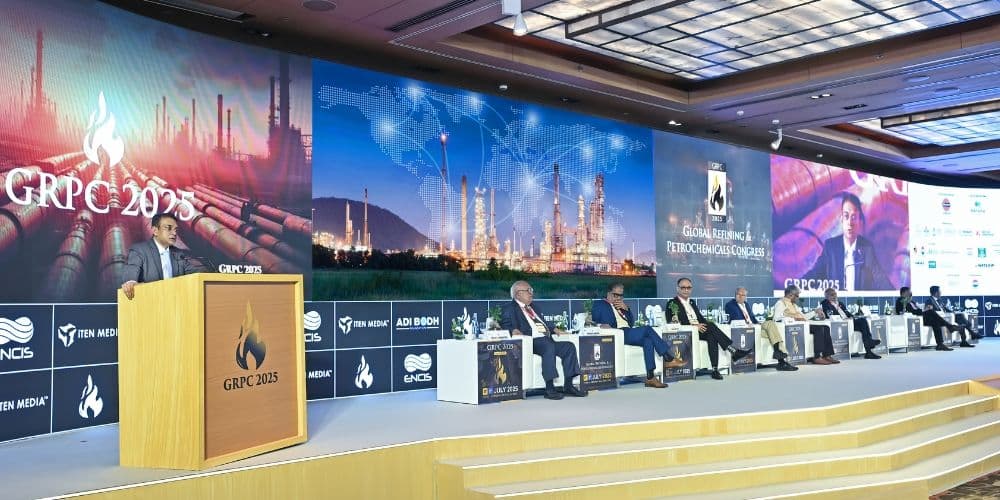
The 10th Global Refining & Petrochemicals Congress (GRPC) will be held on June 24–25, 2026, in New Delhi, bringing together the refining and petrochemical community at a time when the fundamentals of downstream strategy are shifting. Organised by the Energy & Climate Initiatives Society (ENCIS) and co-organised by ITEN Media Pvt Ltd, with EnergDive as the official host publication, the forthcoming edition arrives as companies confront structural choices around decarbonisation, integration, circularity and digitally-enabled operations.
Why the Tenth Edition Matters Now
Across a decade, GRPC has built a significant footprint: earlier editions brought together more than 6,000 participants from 750 organisations across over 50 countries. Its value lies not just in size but in the diversity it convenes refiners, petrochemical producers, researchers, technology firms and policy voices engaging in the same forum. With transition pressures touching every part of the value chain, that shared vantage point has become increasingly scarce.
The Shift from Incremental to Structural Decisions
The downstream sector is moving through a moment when long-standing operating assumptions are being re-evaluated. Mobility patterns are changing, global trade dynamics are shifting and expectations around emissions and materials management have grown sharper.
These dynamics are pushing companies to reassess how their assets are configured and how their product portfolios should evolve. This shift is no longer about squeezing out marginal efficiency gains.
It involves revisiting the structure of refining and petrochemical systems themselves. Planning cycles have tightened as operators separate what can be done within existing configurations, what requires new infrastructure or partnerships and what belongs to longer investment horizons.
ENCIS Director General Abhishek Bhatnagar notes that the sector is preparing to function within a “carbon-constrained market,” a reality now embedded in how companies model demand, margins and risk.
Five Imperatives Framing GRPC 2026
The 2026 edition is anchored in five imperatives carried forward from GRPC 2025: scaling decarbonisation technologies; advancing refinery-to-chemical integration; developing circular-feedstock pathways; embedding digital and AI-driven operations; and aligning policy, finance and workforce capability with transition needs. These imperatives serve as the analytical lens through which the upcoming discussions will take shape.
What Delegates are Coming to Clarify
GRPC provides the setting where sector-wide pressures are converted into decision pathways. Delegates rely on the congress to understand which transition routes are practical in the Indian context, what levels of investment and capability they require, and how each option influences operational stability and long-term competitiveness.
Technical sessions break down the enabling technologies, process adjustments and digital systems that determine whether a project can move ahead. Leadership discussions, in turn, examine market direction, capital priorities and organisational readiness. Together, these conversations offer a clearer picture of what can be advanced immediately, what needs coordinated effort across stakeholders and what must be approached as a longer-cycle transition.
The Network Effect of GRPC
The exhibition floor brings a working dimension to GRPC, functioning as the place where operators, technology providers and system integrators test the practicality of transition ideas. Here, companies move beyond presentations to examine actual equipment, digital platforms and process solutions, often with the engineers and developers who built them. These interactions allow decision-makers to probe fit, scalability and operational impact in ways that formal sessions cannot. For a sector where progress depends on integrating chemistry, hardware and digital layers into complex plants, such direct, technical engagement becomes essential. It is in these side-floor conversations where bottlenecks are identified, deployment risks are assessed and potential partnerships are first sketched out that many transition projects begin to take real shape.
What the 2026 Edition Could Shape
Downstream strategy is increasingly defined by operational feasibility, capital efficiency and long-term positioning. GRPC 2026 sits at the intersection of these variables. Sharper clarity on technology readiness, integration economics, infrastructure needs and the alignment of policy and finance could directly shape how companies sequence investments, redesign assets and plan for the decade ahead.
The downstream sector is entering a phase where decisions carry multi-cycle implications. GRPC 2026 is not merely another conference; it functions as a calibration point for an industry navigating structural change.
The deliberations in New Delhi will influence how India’s refining and petrochemical operators chart their next steps.