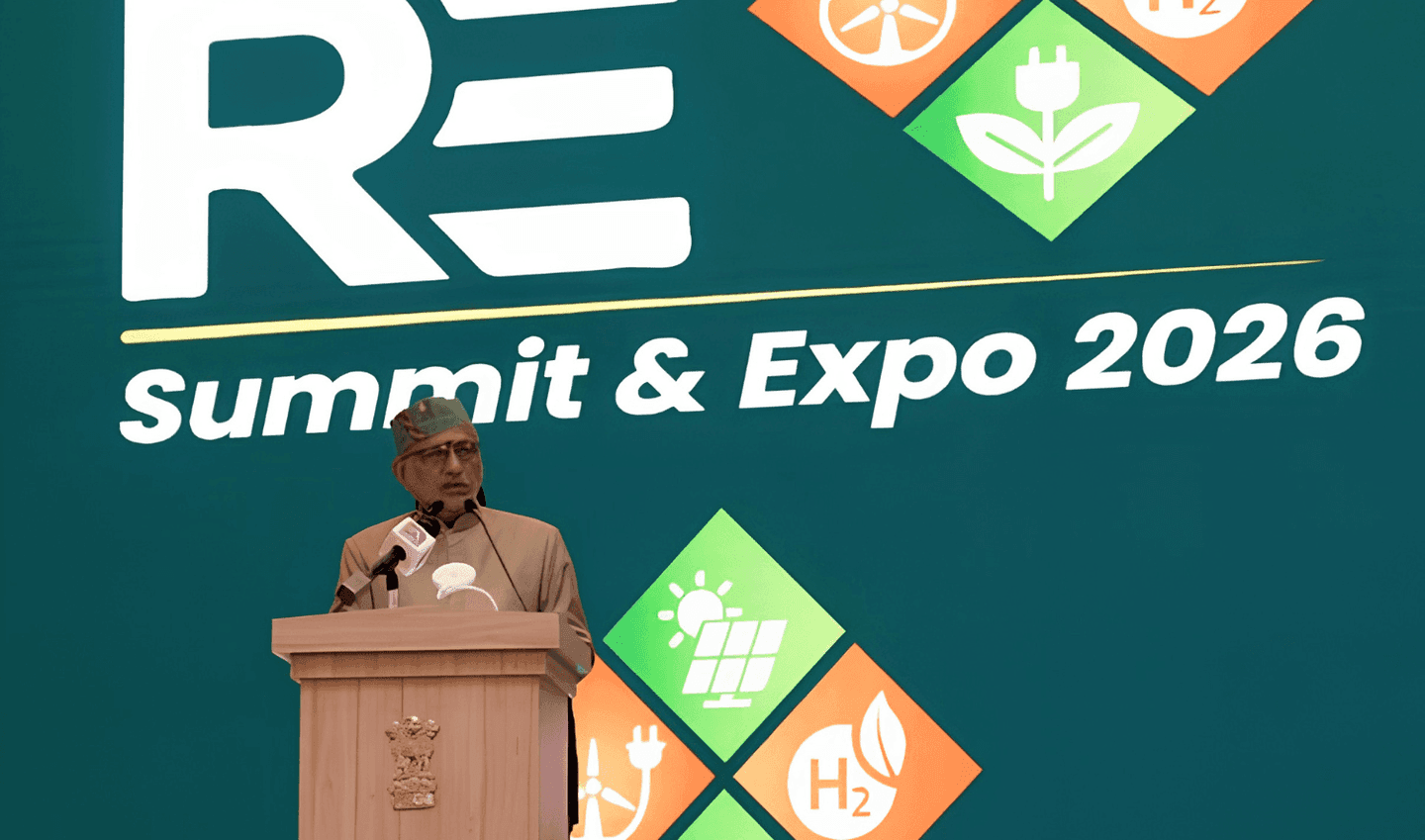
India’s remarkable progress in renewable energy demonstrates that environmental commitments are not a hindrance to economic growth but a catalyst for the country’s development journey, said the Vice President, CP Radhakrishnan, while addressing the Valedictory Session of the Bharat Renewable Energy Summit & Expo 2026 here today.
The Vice President highlighted India’s achievements in the renewable energy sector, its commitment to sustainable development and the transformative role of clean energy in empowering households, farmers and communities across the country.
The Vice President said that the progress achieved over the last decade vindicates Prime Minister Narendra Modi’s vision that environmental commitments are catalysts for growth, delivering greater energy access, lower industrial costs, employment opportunities and reduced import dependence. Calling for stronger industry-academia collaboration, he said, “The technologies of 2040 will come from the laboratories and start-ups of today,” emphasising the importance of research, innovation and entrepreneurship.
Union Minister for New and Renewable Energy, Education and Consumer Affairs, Food and Public Distribution, Pralhad Joshi, said that India’s Renewable Energy sector has attracted more than ₹15 lakh crore in investment over the past decade, while addressing the ceremony. He said that nearly ₹6 lakh crore had flowed into the sector in just the last two years.
Joshi stated that BRE Summit & Expo 2026 is the largest renewable energy event hosted in India, with over 75,000 visitors from 135 countries, participation from more than 32 international Ministers, and over eight partner countries and the European Union. The Summit also brought together 14 States and Union Territories as partners, six Chief Ministers, 10 State Energy Ministers, over 400 exhibitors, more than 620 speakers and 113 sessions. It also featured the 9th International Solar Alliance Assembly and the 4th International Conference on Green Hydrogen.
The Union Minister stated that four days ago, participants had come together with a shared ambition to shape the next phase of the global energy transition. As the Summit concluded, he expressed pride in the achievements and stated that India had taken its renewable energy story to the world. He said that the Watts Next forum brought innovators together, while the Next Terawatt Ministerial Plenary addressed integrated energy planning, resilient infrastructure, storage and financing.
Joshi further highlighted a major decision taken the previous day, under which the Union Cabinet, chaired by Prime Minister Shri Narendra Modi, approved a ₹14,500 crore Viability Gap Funding (VGF) scheme for the development of 92 GWh of grid-scale energy storage capacity. This includes 30 GWh of Battery Energy Storage Systems (BESS), 60 GWh of Pumped Storage Projects (PSPs) and 2 GWh through new technologies.
He also stated that India had achieved utility-scale solar generation costs of USD 30–35 per MWh (₹2,840–₹3,313), the lowest in the world. Renewable energy has helped India save more than $100 billion in fossil fuel imports, equivalent to approximately ₹9.46 lakh crore.
Joshi further highlighted that in 2025, India auctioned 15 GW of hybrid renewable energy projects, taking the total auctioned capacity to 64 GW, with both figures representing the highest volumes anywhere in the world. The average tariffs achieved between 2023 and 2025 stood at around $ 45 per MWh (₹4,260), which was 20 per cent below the average cost of electricity from coal-fired power plants.
Highlighting India's growing manufacturing capabilities, the Minister stated that solar module manufacturing capacity had crossed 225 GW, making India the world's second-largest manufacturer of solar modules. He further stated that distributed solar capacity for self-consumption would exceed 100 GW by 2030.