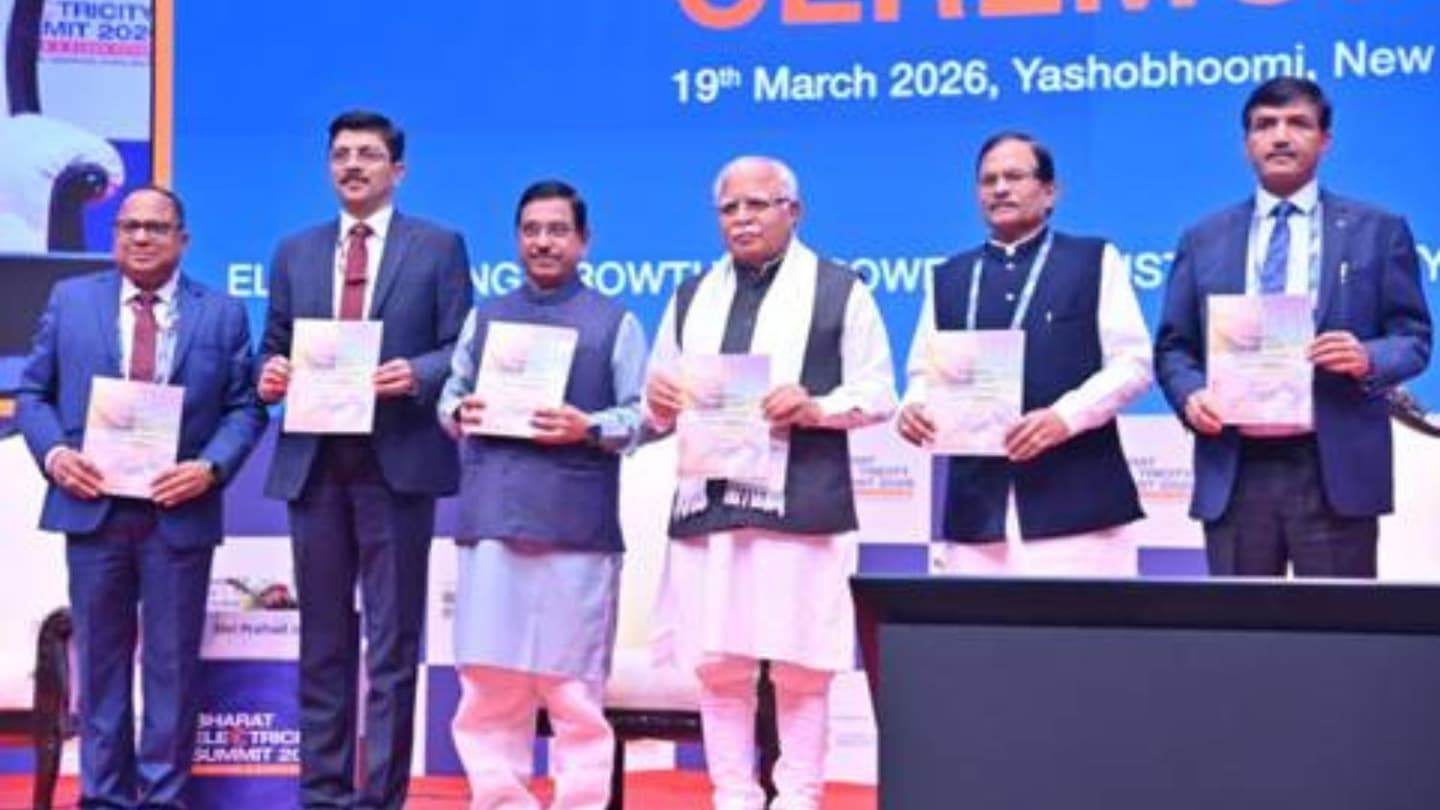
The government on Thursday unveiled two key plans to support the integration of over 900 GW of non-fossil fuel capacity by 2035–36, outlining a roadmap for grid expansion and resource adequacy at the inaugural Bharat Electricity Summit 2026.
The plans — the National Resource Adequacy Plan and a detailed transmission blueprint — aim to meet rising electricity demand while ensuring grid stability amid rapid renewable energy expansion.
The transmission roadmap proposes the addition of around 1,37,500 circuit km of lines and 8,27,600 MVA of substation capacity, with an estimated investment of ₹7.93 lakh crore to support renewable energy evacuation and strengthen grid resilience.
Speaking at the summit, Union Power Minister Manohar Lal said India’s power sector is entering a phase driven by innovation, affordability and global collaboration, while highlighting the country’s shift from a power-deficit to a power-surplus system.
He also pointed to strong growth in renewable energy capacity, with solar expanding from 2.8 GW to over 143 GW, alongside rising electricity demand, which crossed 250 GW in 2024–25 and is projected to reach 270 GW and beyond.
This comes as India scales up power infrastructure to support large-scale renewable integration while maintaining grid reliability and meeting rising demand.
Union Renewable Energy Minister Pralhad Joshi said thermal power would continue to play a stabilising role in the energy mix, even as renewables remain central to long-term sustainability.
Minister of State Shripad Naik said India’s installed power capacity has more than doubled since 2014, with increasing participation from households and farmers in clean energy generation.
Power Secretary Pankaj Agarwal said India now operates one of the world’s largest synchronised grids, supported by smart metering, advanced balancing systems and evolving policy frameworks.