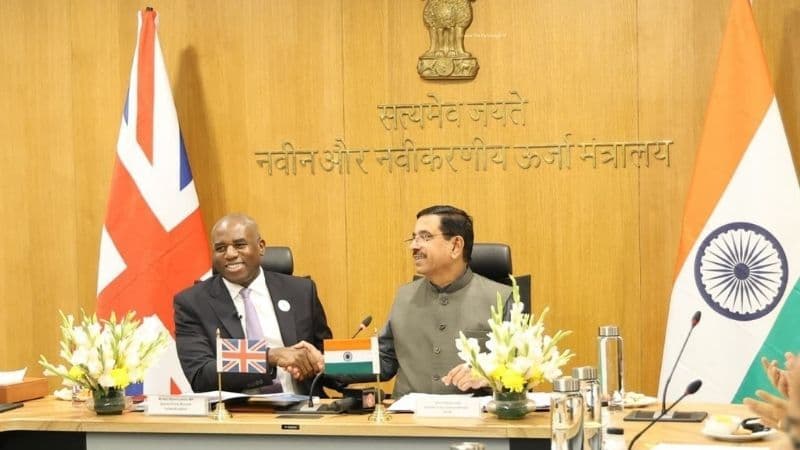
India and the United Kingdom on Tuesday launched a joint Offshore Wind Taskforce aimed at accelerating cooperation in the offshore wind sector, with Union Minister for New and Renewable Energy Pralhad Joshi describing it as a platform focused on “execution rather than symbolism.
The Taskforce was launched in the presence of UK Deputy Prime Minister David Lammy and British High Commissioner to India Lindy Cameron. It has been constituted under Vision 2035 and the Fourth Energy Dialogue between the two countries.
Calling it a “Trustforce”, Joshi said the mechanism is intended to deliver time-bound workstreams, measurable milestones and visible progress. He said while the United Kingdom has demonstrated global leadership in scaling offshore wind and developing supply chains, India brings long-term demand, scale and a rapidly expanding clean energy ecosystem.
The Minister outlined three broad areas for cooperation: ecosystem planning and market design, including refined seabed leasing frameworks and revenue-certainty mechanisms; infrastructure and supply chains such as port modernisation, local manufacturing and specialised vessels; and financing structures that can mobilise long-term institutional capital through blended finance and risk mitigation frameworks.
India has identified promising offshore wind zones off the coasts of Gujarat and Tamil Nadu. Grid planning and surveys for initial projects have been undertaken through the National Institute of Wind Energy. To support early-stage development, the government has introduced a Viability Gap Funding (VGF) scheme with a total outlay of ₹7,453 crore.
Joshi said offshore wind would play a strategic role in strengthening reliability, grid stability, industrial competitiveness and energy security as India moves into the next phase of its energy transition.
He also linked offshore wind deployment with India’s green hydrogen ambitions, noting that coastal renewable energy can support emerging hydrogen and industrial clusters. India is leading the Hydrogen Breakthrough Goal under the international Breakthrough Agenda and has rolled out the National Green Hydrogen Mission to promote domestic production.
According to the Minister, India’s installed non-fossil fuel capacity has crossed 272 GW, including over 141 GW of solar and 55 GW of wind capacity. In the current financial year, more than 35 GW of solar and 4.61 GW of wind capacity have been added.
Officials said offshore wind remains one of the more complex segments of the energy transition, requiring marine logistics, specialised port infrastructure, seabed leasing clarity and bankable commercial frameworks.
The Taskforce is expected to provide strategic coordination to address these challenges and strengthen long-term India–UK cooperation in clean energy under Vision 2035.