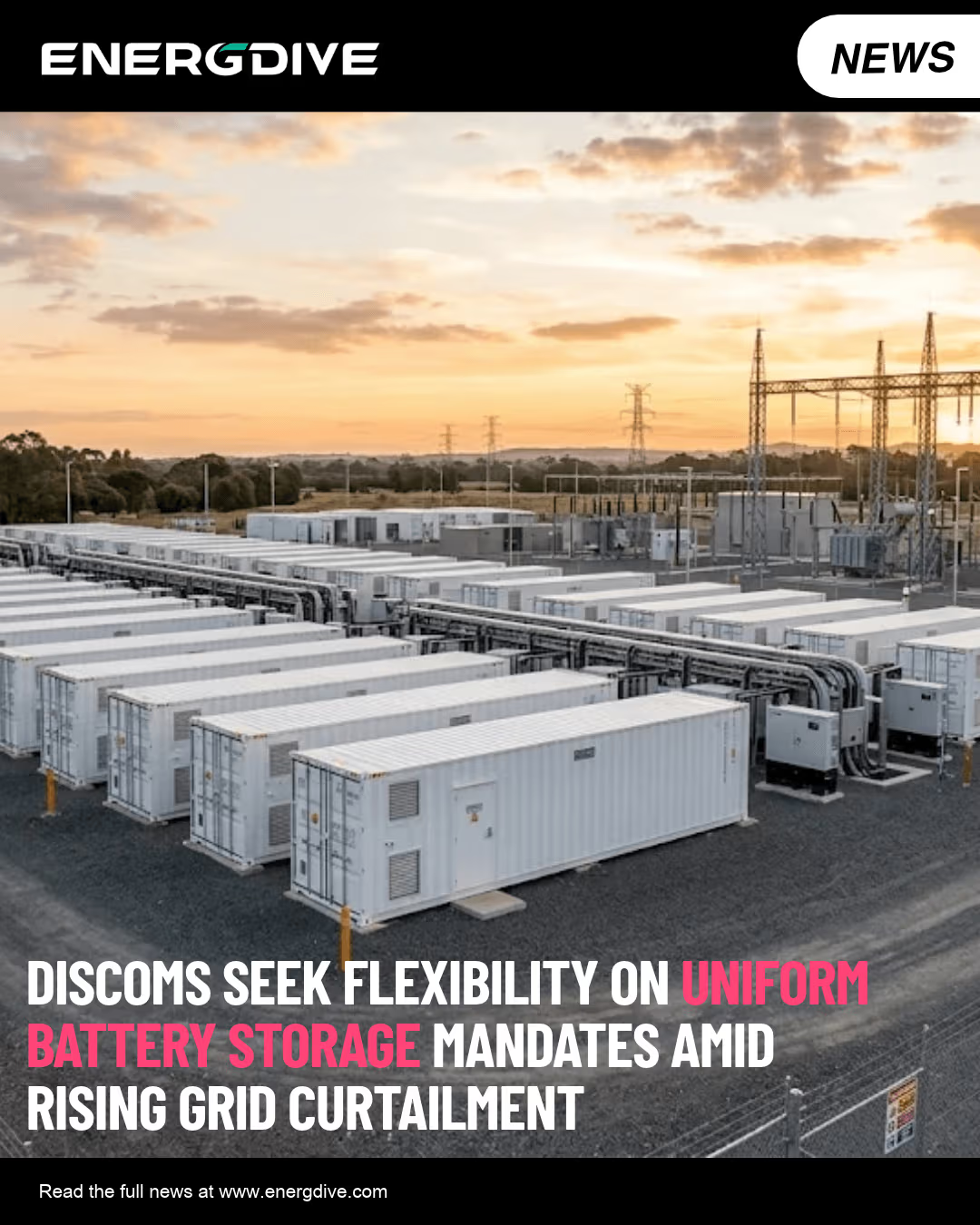
New Delhi: India’s power distribution companies (Discoms) have urged the Ministry of Power to introduce state-specific flexibility in the proposed mandatory Battery Energy Storage System (BESS) procurement framework, citing variations in regional electricity demand, renewable energy absorption capacity and financial strength. The All India Discoms Association (AIDA) has submitted a representation to the Ministry of Power, cautioning that uniform energy storage procurement obligations could further strain the finances of already debt-laden distribution utilities. The association has called for a differentiated approach that accounts for individual states' power consumption patterns and operational requirements. The Centre is working towards finalising the procurement framework most probably by March 2027, with minimum storage procurement requirements of about 10–20% of peak demand and two-hour discharge durations reportedly under consideration.
AIDA also highlighted that states with significant daytime agricultural electricity demand are better positioned to absorb midday solar generation, compared with industrial-load regions where consumption patterns differ. It argued that imposing identical storage obligations across states could result in inefficient capacity utilisation and additional financial pressure on Discoms. To address these concerns, the association proposed an operational expenditure (OPEX)-based procurement model through aggregated tenders facilitated by the Solar Energy Corporation of India (SECI). The proposed measures, it said, would help strengthen grid integration while preventing additional costs from being passed on to electricity consumers of India.