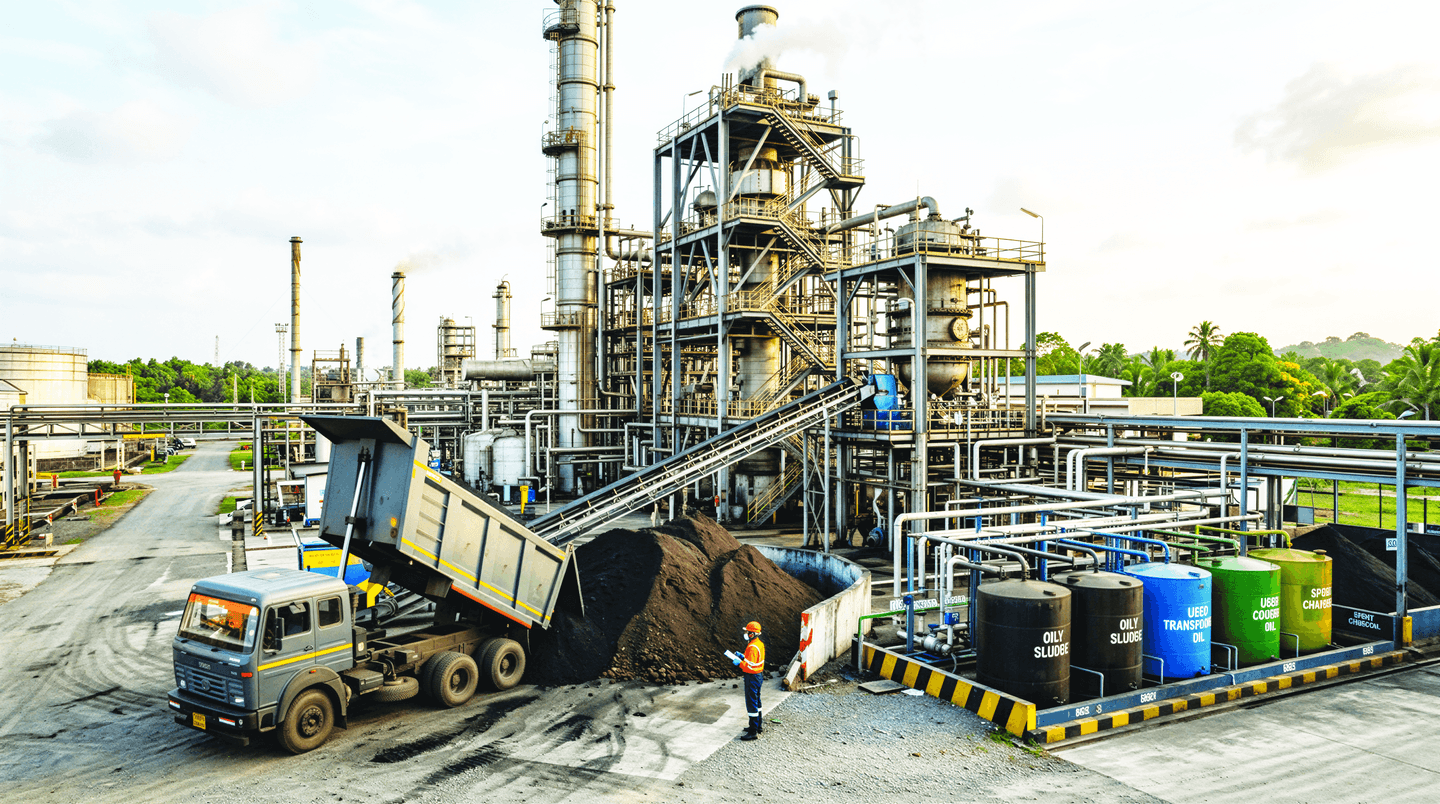
Earlier, the management of oily sludge was posing significant environmental and operational challenges. Large volumes of sludge were generated from ETPs, crude tank bottoms, and maintenance activities. The sludge, being hazardous in nature, used to be stored in designated pits or lagoons, leading to potential risks of soil and groundwater contamination due to seepage or overflow, especially during monsoons. The conventional disposal methods were landfilling through an authorised Treatment, Storage and Disposal Facility (TSDF), incineration, and others, which incurred high transportation and disposal costs, while posing long-term environmental liabilities. Storage of untreated oily sludge was occupying large valuable space within the refinery premises, increasing the operational complexity.
Used Transformer Oil (UTO) is generated during the electrical equipment maintenance in refineries. It contains degraded hydrocarbons and oxidation products, among others. UTO is classified as hazardous waste under Schedule I of the Hazardous Waste Rules. Earlier, the disposal of UTO was similar to that of oily sludge.
Used Cooking Oil (UCO) contains harmful compounds like aldehydes and free radicals, which contribute to inflammation and other health problems. Earlier, UCO was being treated in STP / ETP, which was increasing the load as well as affecting inlet feed characteristics.
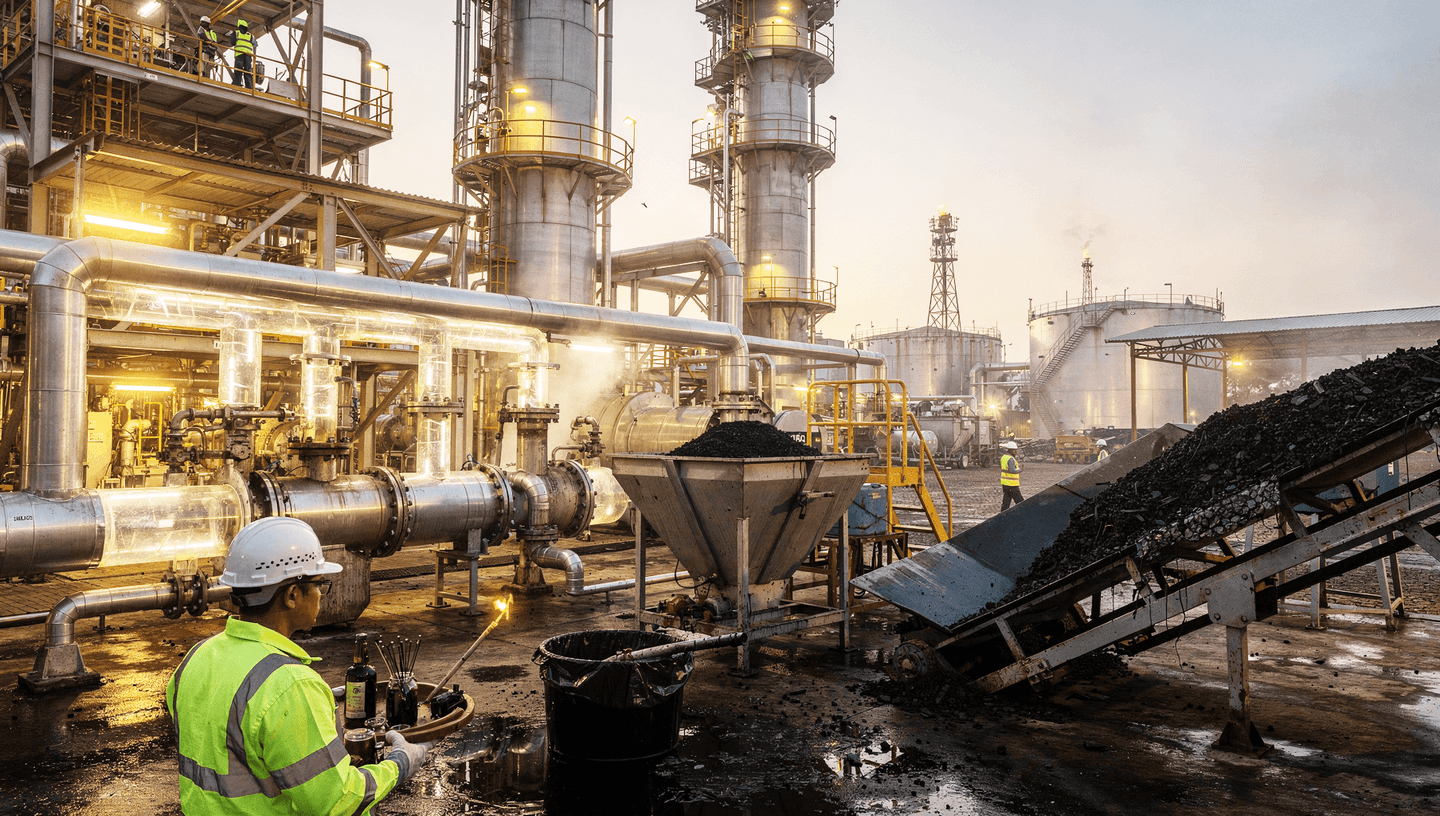
In refineries, spent charcoal is generated from the Effluent Treatment Plant (ETP), Amine Treatment Unit, and VOC Adsorbers, among others. This is also classified as hazardous waste due to its adsorbed hydrocarbons and contaminants. Earlier, the disposal of spent charcoal was done similarly to that of oily sludge.
Kochi Refinery has always been at the forefront of protecting the environment. Being a socially responsible corporate, to demonstrate proactive waste minimisation and implement sustainable waste management practices, idea was explored to reprocess oily sludge, UTO and UCO in the Delayed Coking Unit (DCU), which was set up for vacuum residue upgradation. Another idea was to mix spent charcoal in a controlled manner with petroleum coke, which is the byproduct of DCU.
Objectives
The objectives is to protect the environment by minimising waste, recover valuable hydrocarbons for its reuse in refining processes/fuel blending, promote sustainability in refining operations, and create energy and wealth from waste.
Methodology
The DCU is a thermal cracking unit designed to convert heavy residue streams such as vacuum residue into lighter hydrocarbon fractions and petroleum coke. It operates at temperatures of 480 - 520°C and pressure of 1–2 bar. The following methodology has been adopted to implement the ideas:
• Water content is reduced to less than 50 percent from the oily sludge, followed by its homogenisation to maintain uniform consistency
• UTO is tested to ensure the absence of Polychlorinated Biphenyls (PCB), heavy metals, and halogens
• Oily sludge along with a controlled quantity of UTO and UCO (less than 10 percent) is injected into the bottom section of the coke drum of DCU
• Upon injection, the hydrocarbons in the sludge undergo thermal cracking, get vaporised into lighter fractions which exit the drum and are routed to the fractionator
• The non-volatile, solid portion of the sludge remains in the drum and contributes to pet coke formation
• Further, spent charcoal is mixed with pet coke at a controlled rate. The mixture is thoroughly blended to achieve the uniform composition and calorific value of pet coke
Challenges
Oily sludge has inconsistent composition in terms of water, solids, oil, heavy metals, and others, which makes it difficult to predict the processing strategy. Inorganic solids like rust, sand, and spent catalyst, among others, increase the pet coke yield; however, reduces its quality and cause fouling in the downstream section of coke drum. Acidic compounds like sulfur and chlorides present in the oily sludge cause corrosion in the associated equipment.
Delayed coking unit was installed for the upgradation of low value heavier hydrocarbons
Implementation
Delayed Coking Unit was installed for the upgradation of low value heavier hydrocarbons. An opportunity was identified to use DCU for the reprocessing of waste material, and the same was implemented after the commissioning of DCU.
Normally, 10,000 MT of oily sludge is generated in a year, which has around 60 percent of hydrocarbon, corresponding to 6,000 MT. In this process, around 3,000 MT light hydrocarbons (gases, naphtha, and gas oil) and 2,500 MT of coke is recovered. Therefore, around 92 percent of hydrocarbons are recovered through this initiative.
Qualitative Outcomes
The initiative has helped in protecting the environment through waste minimization. Valuable hydrocarbons are being recovered. This has promoted sustainability in refining operations. The initiative has turned the waste material into a source of energy as well as wealth. After implementing this initiative, the quantity of waste material being disposed of through TSDF has significantly reduced, which in turn has improved the surrounding environment.
Innovation & Uniqueness
The resemblance of the waste material to vacuum reside which is the typical feedstock for DCU, was identified by Kochi Refinery. It was their unique innovation to use DCU for the reprocessing of oily sludge, UTO, UCO, and spent charcoal. It is a perfect example of the circular economy.
Scalability & Replicability
The idea is replicable in nature and can be implemented across the refineries where DCU is available. This can also be thought of implementing where Vis Breaker Units (VBU) are available. The UCO and UTO are widely available across the industries. The idea can be implemented in all the thermal cracking units.
Key Learnings
The existing facility could be utilised for different applications like waste processing. Earlier, the money was spent on the disposal of waste, which turned out to be wealth and energy creator.
The existing facility could be utilised for different applications like waste processing. Earlier, the money was spent on the disposal of waste, which turned out to be wealth and energy creator
Future Plans
A study is being carried out to maximise sludge processing, and the target is zero sludge generation from the refinery. As sludge processing impacts the metallurgy, a study shall be done for its protection.
This case study is based on a sustainability case study submitted by Bharat Petroleum Corporation Ltd (BPCL) to the Petroleum and Natural Gas Regulatory Board (PNGRB), with inputs attributed to Roshan Sihab PM, General Manager (HSE), Kochi Refinery.