Data from the Central Electricity Authority (CEA) and the Ministry of New and Renewable Energy (MNRE) for April 2026 compiled by ENERGDIVE shows that India has been able to cater to the rising electricity demand. While traditional power sources remain the country’s bench strength of electricity generation, it remains focused on renewable energy capacity addition, with solar continuing to drive the country’s renewable energy story.
In April 2026, the country’s power sector generated 166.30 BU of electricity. It sourced 120.90 BU from thermal, 5.15 BU from nuclear, 10.76 BU from large hydro power, 29.38 BU from Renewable Energy Sources (RES), including small hydro power, and 0.11 BU from neighbouring Bhutan.
This underscores the dominance of thermal power as it contributed 73 percent of total electricity generated in the country during the month, with distantly followed by RES at 18 percent contribution. The data indicate that conventional power sources remain the backbone of the country’s power supply, as renewable capacity continues to be added to meet rising electricity demand and maintain grid stability.
In the same month, India recorded a peak demand of 2,56,436 MW. However, it was able to meet 99.9 percent of peak demand with a marginal shortfall of 319 MW. This points to a high satisfaction rate, despite demand continuing to exert pressure on the power system during peak consumption periods, underscoring strong grid reliability amid rising power consumption.
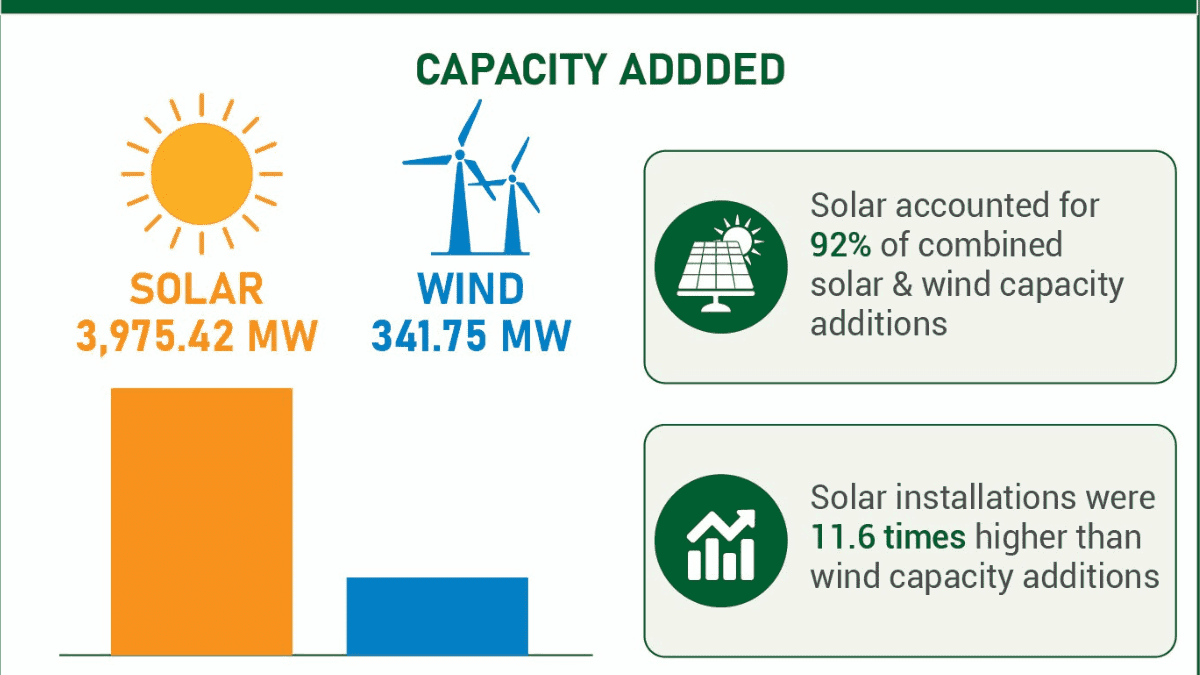
In April 2026, India added solar capacity of 3,975.42 MW and wind capacity of 341.75 MW. The solar installation comprised 92 percent of the combined solar and wind capacity additions. Besides, solar capacity additions were 11.6 times higher than the wind capacity additions, reflecting strong investor interest and faster project execution.