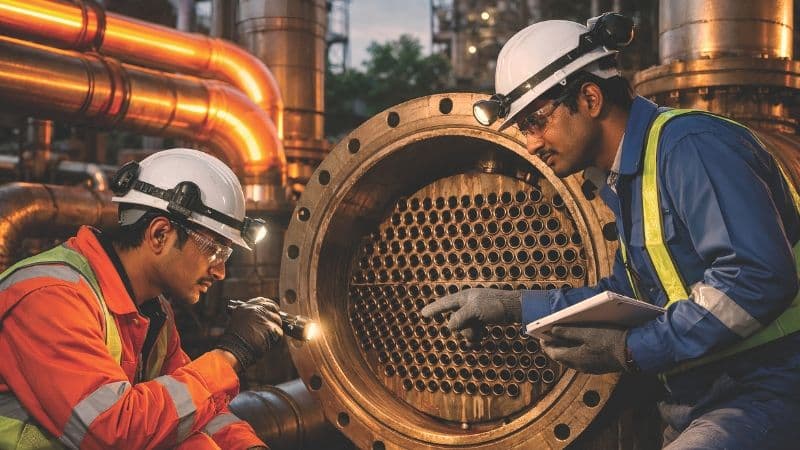
Refineries across the world face the same slow decline in thermal performance. Over time, exchanger tubes accumulate deposits that insulate surfaces, reduce heat transfer and force furnaces to compensate with higher firing. Cleaning restores output only temporarily, and each maintenance shutdown costs production days and fuel efficiency. A more durable remedy is now available: a compact insert that continuously mitigates fouling from within the tube itself.
Fouling and its Consequences
Fouling remains one of the most persistent barriers to energy efficiency in refineries. As process fluids pass through exchangers, deposits form inside tubes, reducing heat-transfer efficiency and limiting throughput. The result is lower furnace-inlet temperatures, higher pressure drop and shorter operating cycles. These effects translate directly into greater fuel consumption, higher CO2 emissions and more frequent cleaning. Over time, this loss erodes both profitability and plant availability.
A Retrofit Approach for Existing Exchangers
A practical response now exists in the form of tube-insert technology designed to enhance the efficiency of existing assets while reducing emissions. The inserts are fitted inside exchanger tubes during scheduled shutdowns and generate mild turbulence and controlled vibration, slowing the build-up of deposits and maintaining a steadier heat-transfer coefficient. It is a retrofit measure, not a redesign, allowing refineries to recover performance without replacing hardware. Three insert types are offered — Fixotal, Spirelf and Turbotal — each engineered to induce turbulence and maintain tube cleanliness. The additional pressure drop is modest, typically 0.1 to 0.2 bar per pass at one metre per second flow velocity, well within most refinery hydraulic limits.
Longer Runs in Crude-unit Service
Field data from crude-unit preheat trains demonstrate the scale of improvement. Exchangers fitted with Spirelf inserts have operated continuously for six years without removal, compared with annual cleaning before installation.
The fouling factor was reduced eightfold, while the overall heat-transfer coefficient remained stable throughout the period.
Charts comparing operation before and after installation show a sharp decline in U-value during the original runs, replaced by an almost flat curve after retrofit. The inserts effectively stopped the normal loss of performance, allowing the unit to maintain furnace-inlet temperatures without extra firing.
Measured Energy and Emissions Rains
A second crude-unit case using Turbotal inserts quantified the benefit over two identical 183-day periods. During the reference run, the system recovered 36,400 giga calories of heat; after retrofit, recovery rose to 56,000 giga calories, a gain of 19,600 giga calories in six months. The improvement equated to about 2,000 tonnes of oil equivalent saved and roughly 6,000 tonnes of CO2 emissions avoided. These results show how mechanical efficiency directly translates into decarbonisation. Every giga calorie recovered reduces furnace fuel demand, proving that energy-efficiency improvement equals CO2 reduction.
Mechanism and Performance
The inserts work by increasing turbulence and producing a self-cleaning effect that limits deposit formation and maintains the U-value. The controlled internal motion disrupts the boundary layer inside each tube, preventing material from adhering and hardening. Over time, this reduces fouling growth, stabilises pressure drop and keeps outlet temperatures consistent. Field data from crude-unit service showed an eight-fold reduction in fouling factor and stable U-values over several years of operation. The exchanger surface remains active for longer, improving both reliability and energy efficiency.
Applications across Refinery Services
Although the most detailed examples come from crude-unit trains, the same principle has been applied successfully in residue services, hydrotreaters, hydrocrackers, reboilers, air coolers and U-tubes. Across these units, the pattern is consistent: duty maintained or improved, operating cycles extended, and cleaning frequency reduced. Each service uses an insert geometry tuned to its specific flow regime and fouling behaviour.
Operational Integration
The inserts operate continuously throughout production and are inspected or replaced during normal overhauls. As a purely mechanical solution, they require no sensors or control-system interface, and their expected life aligns with exchanger maintenance intervals.
Each exchanger is engineered individually, ensuring that geometry, flow and pressure-drop effects are properly modelled before installation.
Efficiency as a Route to Decarbonisation
Energy efficiency remains the most immediate and verifiable route to lower refinery emissions. The tube-insert retrofit tackles inefficiency at its source: heat loss caused by fouling. By keeping exchangers cleaner and more thermally effective, the plant burns less fuel to reach target temperatures, and the CO2 saving is recorded directly in the energy balance. This practical solution complements digital optimisation and fuel-transition programmes, offering a measurable reduction in energy intensity using the assets already in place. Field evidence confirms that controlling fouling through tube-insert technology delivers tangible results. Heat recovery increased from 36,400 to 56,000 giga calories within six months, run length extended from one year to six, and fouling factors fell eightfold. The outcomes are higher efficiency, lower emissions and fewer interruptions.
In an industry seeking realistic decarbonisation levers, this retrofit demonstrates that meaningful progress can start with physics, not prediction. By improving flow inside a single tube, refineries can unlock significant energy savings across the plant — a small mechanical change with large operational consequences.
This article is based on a technical paper presented by Jean-Baptiste Court, Area Manager, India, Western Europe, Petroval, at Global Refining & Petrochemicals Congress 2025 organised by ENCIS and co-organised by ITEN Media.