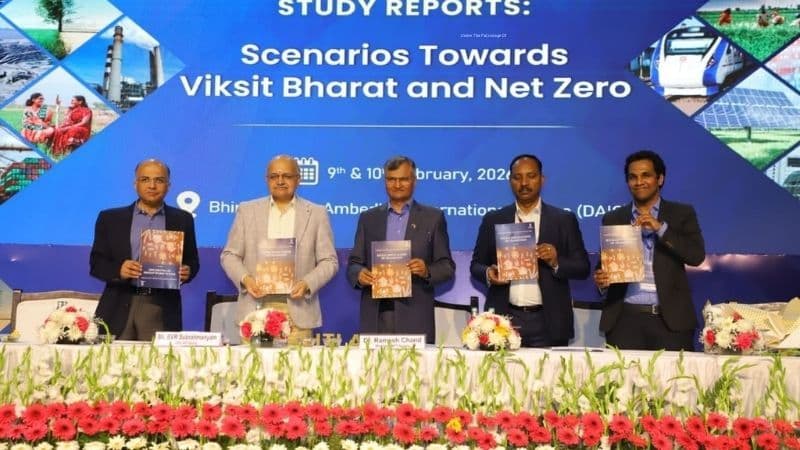
India’s transition to Net Zero by 2070 will be shaped largely by how the country builds its cities, manages waste and electrifies energy use, according to a set of studies released by NITI Aayog under ‘Scenarios towards Viksit Bharat and Net Zero’ series.
The reports project that nearly 86 percent of the building floor space that will exist in 2070 is yet to be constructed, making building design and material choices decisive for long-term energy demand. Air conditioner ownership, currently around 10 percent, is projected to rise to over 80 percent by 2070, underscoring the need for passive cooling design, super-efficient appliances and low-carbon construction materials.
NITI Aayog CEO BVR Subrahmanyam said the scale of construction ahead is unprecedented. “Buildings — office, commercial and residential — have to grow at a magnitude we have not seen in the past. Being a tropical country, cooling load will also go up… Buildings for 2070 need to be built with Net Zero goals in mind from the outset,” he said.
Another report identifies waste as a major energy and resource opportunity, advocating 100 percent door-to-door segregation and large-scale bio-methanation. Waste-to-energy pathways such as Bio CNG, compost and treated wastewater can reduce dependence on virgin resources and cut emissions while strengthening urban circular economies.
On agriculture, the studies recommend a sequenced transition, prioritising micro-irrigation and fertiliser optimisation to raise farmer incomes before large-scale fuel substitution. NITI Aayog Member Ramesh Chand noted that agriculture is both a source and victim of emissions. “We should keep in mind the vulnerability of the agriculture sector to climate change while mapping out the path to Net Zero,” he said.
Member VK Paul described the shift as a human-centred transformation. “The path to Net Zero is fundamentally a path to a more just, resilient and prosperous India,” he said, stressing impacts on land use, health and employment.
The eleven reports represent India’s first government-led integrated modelling exercise linking economic growth with climate goals, examining sectors such as buildings, waste, agriculture and the social implications of the energy transition.