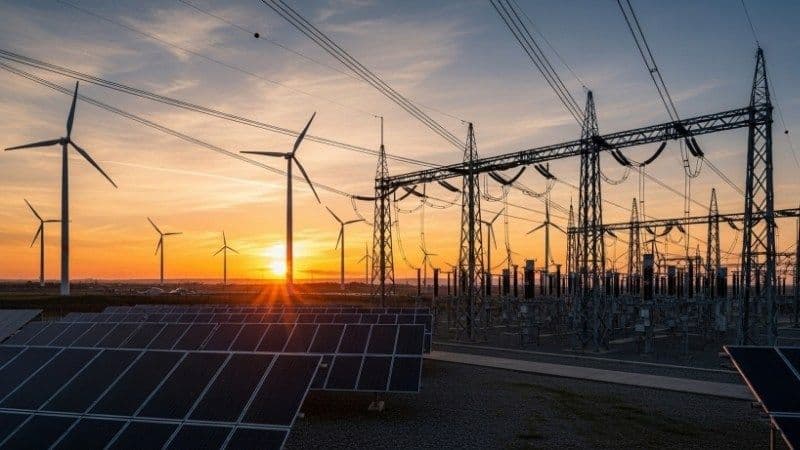
The shift is no longer about adding more power plants; it is about redesigning the entire choreography of generation, flexibility, trading and risk. As millions of small solar rooftops, electric vehicles, batteries and green-fuel technologies prepare to enter the system, India’s electricity market is moving from a centralised command structure to one shaped by algorithms, price signals and near-instant decisions. The question is not whether this transformation will happen, but whether the rules, technologies and market design can keep pace with its speed.
From Fixed Tariffs to Dynamic Price Signals
For decades, electricity for most consumers has been a fixed monthly cost with little choice and even less transparency. But underneath that familiar simplicity lies a wholesale world now being reshaped by volatility, renewables and the need for flexibility.
Dr Manoj Kumar Jhawar, Chairman and MD, PTC India Ltd, observed that “around 85 percent of electricity continues to ride on long-term contracts”, a structure built for stability but not agility. Only about 15 percent of all power finds its way into the short-term market, and a mere fraction of that moves through exchanges. With total system demand frequently above 200 GW, this thin layer of traded energy leaves the market highly exposed to sudden swings in demand or renewable output.
Jhawar believes the future lies in a more deliberate blend: long-term contracts will still anchor investment, but short-term markets must expand dramatically to provide the flexibility required in a renewable-heavy system. Without that added depth, price signals will remain volatile, and flexibility, one of the most valuable services in a modern grid, will remain underpriced.
Regulation in a System that Refuses to Standstill
Matching the speed of physical change with regulatory evolution is proving challenging. Arun Goyal, former Member of the Central Electricity Regulatory Commission (CERC), highlighted that the Power Market Regulations 2021 were deliberately designed to anticipate a more complex ecosystem. They opened the door to green products, high-price segments, an expanded term-ahead market and, notably, market coupling.
Market coupling, by unifying price discovery across all power exchanges, aims to eliminate the structural advantage held by dominant platforms. Goyal pointed out that many distribution companies found bids on smaller exchanges either not clearing or clearing at unfavourable prices, a barrier that a unified clearing engine is intended to remove.
Yet the shift is technically demanding. Every exchange uses distinct bidding formats and algorithms. Under CERC’s plan, even the role of market coupling operator will rotate—a governance experiment with no precedent in India’s power sector. Goyal also warned that technologies such as battery storage and Distributed Energy Resources (DER) are only superficially incorporated in today’s frameworks. For rules to keep pace with innovation, he argued, India will need more expert involvement, agile revisions and real-world pilot projects instead of slow-moving, paper-based consultations.
A Trading Landscape that Finally Feels Alive
The exchange segment offers a glimpse of what a fully liquid power market could look like. Satyanarayan Goel, Chairman and MD, India Energy Exchange (IEX), explained how the real-time market (RTM), which runs 48 auctions a day, has emerged as a breakout product. With API-based bidding now commonplace, utilities and generators are placing automated bids every 30 minutes, allowing them to adjust to shifting renewable generation. RTM volumes, now exceeding 150 million units a day, have outpaced the day-ahead market in recent months.
New products, green RTM, cross-border trades with Nepal and Bhutan, peak-power blocks tailored for battery energy storage systems (BESS) are expanding the contours of what “electricity trading” means. Each contract represents new ways to monetise flexibility and bring renewable-rich portfolios closer to real-time optimisation.
Kapil Dev, MD, New Age Markets in Electricity Pvt Ltd, believes the next untapped opportunity is a mature physical forward market with delivery horizons of one to five years. Such a market, he argued, would bridge long-term certainty and short-term agility, giving developers price visibility and large buyers hedging power. For this to work, Dev emphasised that digital plumbing must evolve into “something that works like UPI for electrons”, a fully integrated workflow where every trade instantly triggers scheduling, metering and settlement.
When Gas Markets and Power Markets Meet
Electricity cannot fully decarbonise if its flexibility backbone remains expensive. Rajesh K Mediratta, CEO and MD, India Gas Exchange, noted that the country’s 25 GW fleet of gas-fired power plants—once expected to run at high load factors remains largely underutilised because imported Liquefied Natural Gas (LNG) is costly.
A true gas–power coupling model, where generators buy spot gas on the exchange and sell power on exchanges whenever the spreads work, has remained elusive because of pipeline rules. Today, pipeline operators can take up to three days to confirm capacity—unthinkable in a market where electricity trades on a 15-minute cycle.
Progress is emerging pipeline operators, with support from policymakers, have started offering day-ahead and intra-day capacity specifically for power plants. Mediratta noted that generators can now receive evening dispatch instructions, buy gas within an hour and get it delivered in time to meet peak demand. Institutionalising this flexibility—not relying on temporary permissions could unlock meaningful cross-commodity trading and revive stranded gas assets.
A Renewable-heavy Grid that Needs to Stay Balanced
Flexibility is no longer optional in a grid where instantaneous renewable penetration can exceed 40 percent. Samir Chandra Saxena, Chairman and MD, Grid Controller of India, explained that unexpected monsoon patterns suppressed demand this summer, while high wind output created long stretches of surplus power and ultra-low prices.
These conditions strain both conventional and renewable assets. Ramps of 10–15 GW per hour are now common as evening peaks collide with falling solar output. Tools such as Security Constrained Economic Dispatch (SCED) and Security Constrained Unit Commitment (SCUC) help optimise dispatch at the interstate level, but Saxena underlined the pressing need for states to adopt similar mechanisms and to fully implement the Scheduling, Accounting, Metering and Settlement of Transactions (SAMAST) framework.
Storage is finally entering the ancillary services space. A Delhi-based grid-scale battery has successfully completed automatic generation control (AGC) trials, showing the speed and precision batteries can bring to frequency response. Demand response remains a major but largely untapped frontier, requiring automation, load baselining and new rules that enable consumers to meaningfully contribute flexibility.
Financial Markets Step In: Electricity Futures Arrive
While the physical market is being rewired, the financial layer is just taking shape. Praveena Rai, MD and CEO, Multi Commodity Exchange of India (MCX), positioned electricity futures as the “next layer of the infrastructure stack” a tool that enables generators, Distribution Companies (DISCOM) and industrial consumers to lock in future prices and hedge volatility.
Rai stressed that derivatives can only fulfil their risk-management role if physical and financial exposures are paired intelligently. What India needs, she said, is cross-learning: the financial sector must understand electricity’s physical realities, while the power sector must become fluent in financial hedging strategies. Early trading patterns indicate that futures are beginning to mirror and influence the day-ahead market, a sign that price discovery is slowly maturing across the value chain.
Green Fuels, Digital Twins and the Hardware of a New Grid
Technology firms see an increasingly hybrid system: renewables supported by fast-ramping gas assets, digital tools and smart consumer-side technologies. Shubra Bhatnagar, Director – Engineering, Gas Power, GE Vernova, outlined a three-pillar future built on green fuels, digital intelligence and consumer-centric distribution networks.
Gas turbines capable of burning high hydrogen blends—or even 100 percent green ammonia, as GE Vernova is developing with IHI of Japan—could become vital for balancing as India’s renewable share grows. The company already has more than 9 million operating hours on hydrogen blends across its fleet of 120 turbines worldwide. Meanwhile, stranded gas plants could be repurposed as synchronous condensers to provide inertia and voltage support for a grid increasingly dominated by inverter-based renewable systems.
Digital twins, Artificial Intelligence (AI) and integrated smart grids will be essential to orchestrate a system where electrons can move in every direction—from rooftop solar, to EV batteries, to neighbourhood microgrids.
The Road Ahead: A Marketplace in Motion
What India is building is not merely a cleaner grid, but a smarter marketplace, one capable of absorbing volatility, rewarding flexibility and orchestrating millions of distributed assets with near-real-time intelligence. As markets deepen, storage scales, and digital systems mature, electricity will behave less like a static utility and more like a living economic network, shaped continuously by data, weather, consumer behaviour and price signals.
Success will depend on how quickly regulation can adapt, how seamlessly physical and digital infrastructure converge, and how confidently consumers and industries step into their new role as active market participants. If these pieces align, India could enter 2030 with one of the world’s most agile, transparent and innovation-driven power markets—an ecosystem where electrons move as intelligently as capital and information already do.
This article is adapted from a panel discussion on ‘Electricity Markets 2030: Digital, Decentralised, and Decarbonised’ at Bharat Electricity 2025.