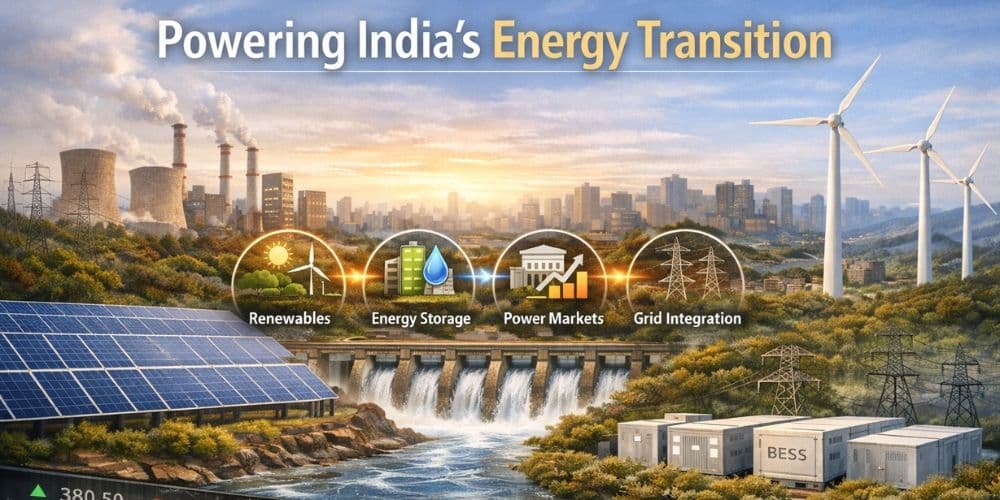
India’s electricity demand is rising faster than projected, driven by urbanisation, industrial expansion and climate-related heatwaves. The country now operates close to 500 GW of installed generation capacity, a figure that has expanded fourfold since the early 2000s. Although clean energy represents almost half of this capacity, it contributes only around 25 percent of actual electricity generated. Bridging this gap is fast becoming the central challenge of India’s energy transition.
Reaching a clean-energy share of 50 percent in electricity generation by 2030 an ambition gaining momentum among analysts and policymakers will require far more than adding new solar and wind capacity. It will depend on addressing risks related to grid integration, financing, regulatory uncertainty and market design that still weigh heavily on investor confidence.
Storage Must Move Centre Stage
India’s generation mix is structurally mismatched with its demand profile. Solar output peaks at midday, wind strengthens in specific seasons, yet national demand peaks most evenings. This misalignment underscores why storage is no longer an optional add-on but a foundational requirement.
PC Garg, Principal Adviser to the National Solar Energy Federation of India (NSEFI) and Former COO of the Central Transmission Utility, says that doubling or tripling renewable installations without adequate storage will not meaningfully increase clean-energy consumption. He adds that shifting renewable output to when it is actually needed is the only way to lift the clean share of electricity consumption to one half.
Garg emphasises that new frameworks such as Renewable Consumption Obligations, which measure actual clean-energy usage rather than installed capacity, reflect this necessary shift in policy thinking. He also warns that global supply-chain fragility, geopolitical disruptions in critical minerals and India’s comparatively high financing costs could slow progress unless addressed through coordinated policy and institutional reform.
A Power Market in Transition, Not Yet a Stable Anchor
India’s power markets are becoming more liquid, but they remain insufficiently mature to provide the revenue certainty required for large-scale renewable investments.
Naveen Munjal, Director, Business Development and Commercial at Apraava Energy, highlights structural weaknesses across distribution companies, whose losses remain substantial. The gap between the average cost of supply and average revenue has widened in many states, and tariff reforms remain inconsistent. These conditions limit the ability of distribution companies to sign long-term power purchase agreements, even though such agreements remain essential for project bankability.
Because of this, power exchanges are still used primarily as balancing tools rather than core procurement channels. Munjal believes the way forward lies in hybrid contracting long-term agreements for baseload stability combined with shorter-term or market-linked instruments for flexibility. He also pointed to the value of regulatory certainty, pricing safeguards and improved payment security to enable greater participation in short-term markets.
Merchant Renewables: A Calculated Strategy, not a Gamble
ReNew is among the few developers in India with an active merchant renewable portfolio.
According to Ankit Rastogi, CGO, ReNew, this approach is a deliberate bet on the future shape of India’s electricity system.
Rastogi explains that merchant exposure diversifies revenue and positions operators to capture value during peak-price windows, especially as storage begins to spread across the grid. He stresses that merchant capacity will complement rather than replace long-term power purchase agreements, which will continue to anchor financing for capital-intensive assets.
He expects short-term green markets to strengthen gradually as industrial consumers seek more customised profiles aligned with their decarbonisation targets. To accelerate this trend, Rastogi believes central agencies such as the Solar Energy Corporation of India and NTPC could play an important role in introducing merchant tenders structured around contracts for difference, which would reduce volatility and strengthen investor confidence.
Regulatory Volatility is Now an Investment Determinant
As renewable penetration rises, disputes have become both more frequent and more complex. Vishrov Mukerjee, Partner, Dispute Resolution and Arbitration, Trilegal, notes that while earlier disputes revolved around payment delays or change-in-law claims, today’s challenges originate from regulatory unpredictability, state-level resistance and procedural delays.
He highlights recurring issues with land approvals, transmission connectivity, rights of way and abrupt withdrawal of banking provisions. In several states, changes to open access, peak charges or intrastate transmission rules have triggered litigation and delayed ongoing projects. These actions, Mukerjee argued, are broadly driven by states’ desire to prevent industrial consumers from shifting away from distribution companies.
He contends that the Electricity Act 2003, though transformative in its time, now requires modernisation. Fragmented state-level regulations, inconsistent interpretation of standard clauses and piecemeal policy corrections have created barriers to long-term investment. A more harmonised national framework, particularly for power contracts, could restore certainty and reduce litigation over the next decade.
Corporate Renewables Face a Turning Point
Corporate and industrial consumers remain a major engine of renewable demand, but their pathways are becoming more complex. Ketan Mehta, MD, Rays Power Infra Ltd, argued that regulatory change is not inherently negative, the problem is unpredictability. When rules shift midstream or apply retrospectively, they undermine investments and delay capacity growth.
Mehta also notesd that banking, once a central pillar of open-access models — is no longer financially viable for distribution companies as daytime power becomes increasingly surplus. Instead, India must move towards a model where renewable developers deliver predictable, dispatchable energy powered by storage and hybrid systems.
He supports time-of-day tariffs, which he sees as essential for aligning demand with supply. By encouraging consumers to shift usage away from peak periods, such tariffs reduce the need for excessive investment in transmission and storage infrastructure, while improving system stability at lower cost.
Building the Conditions for Long-Term System Reliability
India’s renewable-energy transition is entering a phase where ambition must be matched by operational precision. Storage, regulatory clarity, market design, grid expansion and financing reforms now form the core of the agenda. Clean energy has already become the lowest-cost source of new power, but scaling its contribution from one quarter to one half of national electricity generation will require a unified strategy that supports the realities of a flexible, storage-driven grid.
This article is adapted from a panel discussion on ‘Powering India’s Growth: CEO Insights on Generation Strategy, Risk & Regulation’.