India’s rapid infrastructure expansion, industrial diversification and urban transformation have introduced new layers of complexity into the nation’s risk landscape. This moment demands more than incremental reform; it calls for embedding fire safety into the very architecture of national development through technology, governance and culture.
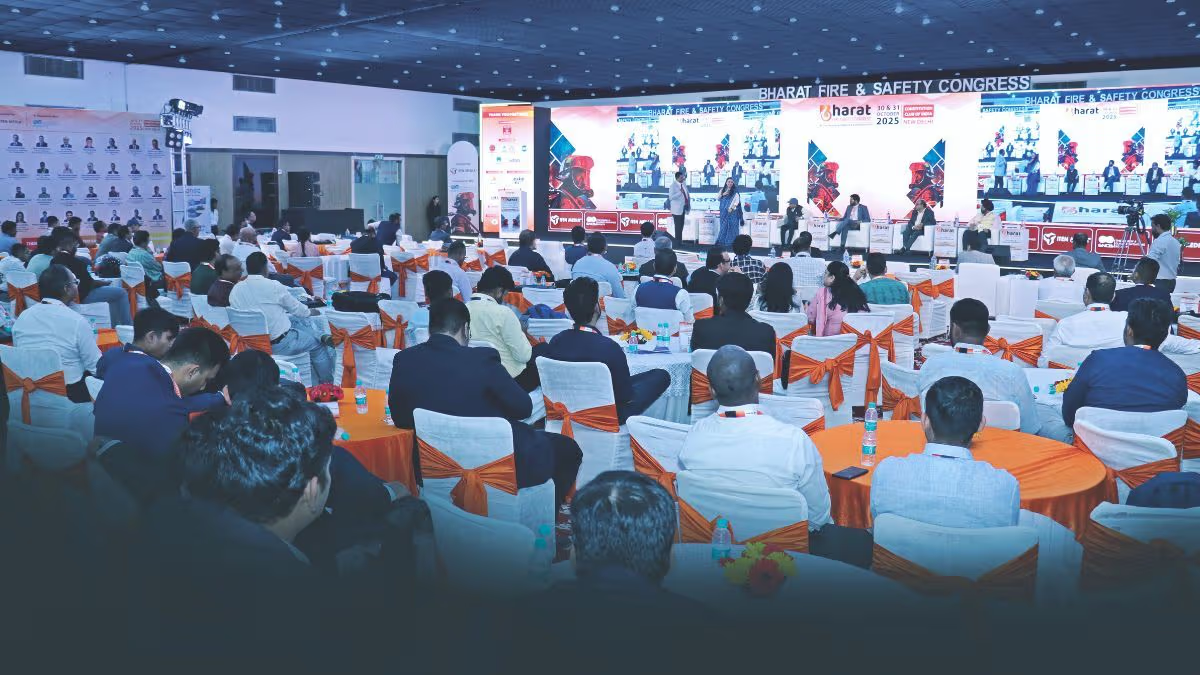
Organised by ITEN Media Pvt Ltd in association with The Energy & Climate Initiatives Society (ENCIS), this year’s Bharat Fire & Safety Congress (BFSC) will be held on May 14–15 at Amaltas Hall, Yashobhoomi, IICC, Dwarka, New Delhi. The 2026 edition marks a deliberate progression in national dialogue. Building on discussions initiated last year, the 2026 theme ‘From Resilience to Readiness: Transforming India’s Fire Safety Landscape’ signals a shift from endurance after disruption to anticipation before crisis.
Reframing the Narrative: From Endurance to Anticipation
The 2026 theme articulates a defining transition in India’s fire safety narrative — from response to readiness, from recovery to prevention. It recognises that true progress lies not merely in absorbing shocks, but in preventing disruption before it occurs.
This reframing extends beyond technological upgrades. It calls for a whole-of-nation approach in which institutions, industries and communities operate in harmony to predict, prepare and protect. Leadership accountability, integrated governance and capacity building are identified as the foundational pillars of this transformation. Aligned with India’s Vision 2047, the Congress positions readiness as a national discipline, one that must be designed into every plan, built into every system and internalised as a cultural value.
Policy, Governance and the New Architecture of Safety
Described as India’s premier national platform dedicated to advancing excellence in fire services, emergency response and industrial safety management, the Congress convenes policymakers, state fire chiefs, industry leaders and global experts to shape the country’s evolving safety architecture.
The leadership, policy and technical tracks reflect this ambition. Sessions such as ‘Fire Safety for India 2047: A National Mission for Safety, Stability & Growth’ and ‘India’s Fire Safety Transformation: Policy, Governance & the New Architecture of Safety’ place regulatory evolution and institutional reform at the centre of deliberation.
Panels on integrated emergency systems, modernising regulation, process safety excellence and navigating risks in high-growth cities indicate that readiness must operate across sectors from urban planning and infrastructure design to high-hazard industries and complex industrial ecosystems.
Digital Intelligence and Technological Modernisation
A central thrust of BFSC is the transition towards predictive, data-driven readiness powered by Artificial Intelligence, the Internet of Things and automation. The programme emphasises how digital fire safety systems, intelligent monitoring and decision platforms can redefine prevention and response.
The parallel Bharat Fire Safety Expo 2026 will serve as a live demonstration of this evolution. It will showcase advancements in fire protection, detection, suppression, infrastructure safety and risk management, alongside a dedicated Start-up and Technology Innovation Zone highlighting emerging FireTech solutions.
This convergence of policy dialogue and technology demonstration underscores a broader strategic message: digital readiness is not an auxiliary feature, but a structural component of modern fire governance.
Building Capability: Talent, Research and Institutional Strength
Readiness, as framed by the Congress, is inseparable from institutional capacity and human capital. The domains on strategic priority include institutional modernisation, talent development, academic collaboration and global standards alignment, signalling that reform must extend beyond equipment to competencies.
The IGNITE Conclave, the industry–academia platform, seeks to bridge curriculum evolution, applied research and workforce needs, fostering co-creation between faculty, researchers, students and industry practitioners. Complementing this, the Call for Papers invites technical research, case studies and actionable insights across areas such as digital readiness, risk-informed urban development, process safety, fire engineering and community preparedness. Selected works will be presented in technical sessions, reinforcing a national knowledge ecosystem.
Recognition and National Movement
The Bharat Fire Safety Leadership & Excellence Awards form an integral component of the Congress, recognising outstanding contributions across fire services, industrial safety, infrastructure design, emergency response, research and community engagement. Through a rigorous and transparent jury process, the Awards aim to set benchmarks in operational leadership and technological advancement. With participation pathways for policymakers, regulators, fire services, researchers, exhibitors, academia and industry leaders, the Congress is positioned not merely as a convening, but as a contribution-driven platform shaping India’s fire safety transformation agenda.
The Bharat Fire Safety Congress 2026 advances a clear proposition: resilience alone is no longer sufficient for a nation scaling infrastructure, industrial capability and urban density at speed. Preparedness must be systemic, anticipatory and embedded within governance frameworks.
By aligning policy reform, technological innovation, institutional strengthening and talent development under a unified theme, the Congress frames 2026 as a pivotal moment in India’s fire safety evolution. In doing so, it seeks to convert aspiration into architecture and transform resilience into enduring readiness for a fire safe Bharat. The Bharat Fire Safety Congress 2026 is supported by Bharat Health, Safety, Sustainability and Environment (HSSE) Council with ENERGDIVE as the official host publication.