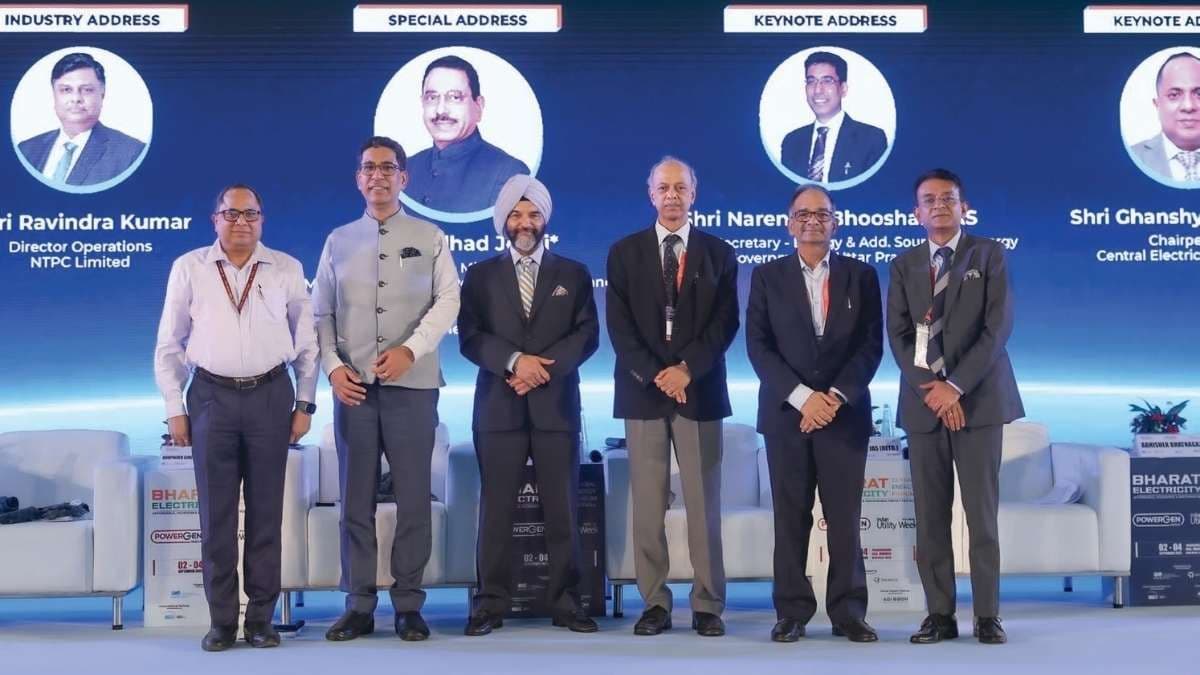
The three-day Bharat Electricity 2025 showed the country’s clean energy story entering a new, more thoughtful phase. India has proved it can add renewable capacity at record speed and the next challenge is to make that growth reliable, affordable and globally competitive. Conversations moved from headline targets to the practical steps needed for balancing the grid as renewables rise, creating long-term signals for investors and manufacturers, aligning with global standards, and building the skilled workforce to sustain momentum.
Rapid Expansion Brings New Complexity
India has added renewable power at remarkable speed. Non-fossil sources now provide over half the electricity grid, and installed capacity has surpassed 246 GW, five years ahead of schedule. Yet scale alone will not secure success.
Bhupinder Singh Bhalla, Former Secretary, Union Ministry of New and Renewable Energy (MNRE) said that the transition is not an obligation; it is a choice and a leadership opportunity, but could stall without discipline on stability and competitiveness.
Echoed PK Pujari, Former Power Secretary, the Government of India, “The next leap in India’s power sector is not about adding gigawatts or megawatts. It is about reimagining the grid itself, moving from a centralised, fossil fuel-based system to a flexible, renewable-rich digital network.”
Grid Reliability at the Core
Grid reliability emerged as the single most pressing challenge. Ghanshyam Prasad, Chairperson, Central Electricity Authority (CEA), pointed to the difficulty of fixing “right” generation mix amid volatile demand. India’s decision to increase coal capacity targets from 80 to 97 GW reflects the need for dependable supply even as tariffs rise and long-term thermal plant viability is questioned. Ambitions to quadruple capacity by 2047 to over 2,000 GW, including a tenfold rise in solar face transmission hurdles such as limited high-voltage direct current infrastructure, right-of-way delays and manufacturing gaps. Prasad noted how demand this year, forecast at 270 GW, fell sharply for months, forcing renewable curtailments and idling thermal units.
NTPC Ltd’s Director for Operations Ravindra Kumar offered an example of transition in action. The company reaffirmed plans to build 60 GW of renewables by 2032 while modernising part of its thermal fleet for flexible operation, adding pumped hydro to handle peak demand and expanding nuclear capacity in partnership with the Nuclear Power Corporation of India Ltd (NPCIL).
Narendra Bhooshan, Additional Chief Secretary, Uttar Pradesh New and Renewable Energy Development Agency, outlined Uttar Pradesh’s ambitious goal of becoming a $1 trillion economy within five years, aligning with the broader roadmap for a Viksit Uttar Pradesh by 2047. Alok Kumar, Director General, All India Discom Association, drew attention to the scale of India’s challenge, stressing that 500 GW of renewables will not be enough to meet the nation’s future energy needs. With total energy demand projected to grow at more than 3 percent CAGR for the next two decades, he underlined the urgency of reducing dependence on imported oil and gas while ensuring affordability, reliability, and sustainability.
Wind Energy Regains Strategic Importance
Wind power remains central to balancing a renewable-rich grid. Vivek Srivastava, CEO, WTG Division, Suzlon Group, emphasised that wind’s steadier output complements solar and strengthens grid stability. India’s wind manufacturing is already deep, with more than 64 percent local content advancing toward 80 percent, compared to solar’s 20 percent. He observed that weak contracting and financing hold back the sector.
Aligning with Global Standards and Trade
Global technical standards and certification are essential for scaling investment and exports. Stephan Hesselmann, Economic Minister Counsellor at the German Embassy in New Delhi, stressed that aligning green hydrogen rules, safety protocols and guarantees of origin with European norms would unlock financing and markets.
Improving solar and battery quality standards would make Indian products globally bankable. Interoperable smart grid and electric vehicle charging protocols would reassure investors. Hesselmann pointed to Germany’s long partnership with India through the Indo-German Energy Forum, GIZ, and KfW as a foundation for faster bilateral and multilateral cooperation.
Affordable clean energy for small and medium industries is vital to maintain competitiveness, especially as Europe’s CBAM will penalise carbon-intensive exports.
Building a Modern, Liquid Power Market
India’s market design has matured but remains shallow. SK Soonee, Former and Founder CEO of POSOCO (now Grid Controller of India), noted that only seven percent of electricity is traded on exchanges compared to 30 to 80 percent in advanced markets.
Former Member of Central Electricity Regulatory Commission (CERC) Arun Goyal highlighted how the Power Market Regulations 2021 introduced new green and long-term products but transaction fees remain high and market coupling between exchanges is technically complex.
Scaling Technology and Manufacturing with Confidence
Technology providers cautioned that India’s fragmented tendering hinders scale. Sandeep Zanzaria, CEO & MD, GE Vernova T&D India Ltd, outlined solutions, including STATCOMs with supercapacitors for grid inertia, distributed energy resource management to handle rooftop solar, and SF free switchgear with much lower greenhouse impact. He urged the adoption of long-term “frame contracts”, multi-year government commitments that give manufacturers the demand visibility to invest in high-voltage infrastructure, advanced grid electronics and storage equipment at scale.
Partnerships and Skilled Workforce
Technology progress depends on skills and collaboration. Dr Vibha Dhawan, Director General, TERI called for co-development rather than one-way technology transfer. Affordable clean energy for small and medium industries is vital to maintain competitiveness, especially as Europe’s Carbon Border Adjustment Mechanism (CBAM) will penalise carbon-intensive exports.
Dhawan urged deeper academic and industry ties to build globally deployable talent, particularly in hydrogen, advanced grid operation and clean manufacturing. She also pointed to initiatives like the International Solar Alliance’s ‘One Sun, One World, One Grid’, which could reduce storage costs by sharing solar power across time zones.
Bharat Electricity 2025 marked a turning point. The discussion moved from counting gigawatts to creating a resilient, market-driven, and globally competitive clean energy system. Leaders urged disciplined grid planning, vibrant power markets, globally aligned standards, deep manufacturing, innovative financing and skilled human capital. If India sustains this focus with consistent policy and international partnerships, it can power inclusive low-carbon growth and become a world hub for clean energy technology, manufacturing and expertise.
Leadership Imperatives for India’s Energy Transition
- Build Execution Certainty: Move from target announcements to assured multi-year project pipelines and coordinated planning across generation, transmission and demand
- Secure Grid Reliability: Expand green corridors, HVDC links, storage, and smart digital controls to manage renewable variability and distributed energy
- Deepen Capital Innovation: Scale corporate bond markets, enable refinancing, and create flexible revenue models for storage and efficiency investments
- Anchor Manufacturing Scale: Use frame contracts and long-term procurement visibility to strengthen domestic supply chains for modules, cells, grid electronics and storage
- Globalise Standards and Markets: Align with international norms in hydrogen, solar, EV and smart grid technology to attract investment and export opportunities
- Invest in Talent: Close the skill gap with future-ready training in hydrogen, digital grid management, energy storage and manufacturing